
Peelable Paint Protection Spray vs TPU Film: Real Price Breakdown in Pakistan and Impact Protection Guide
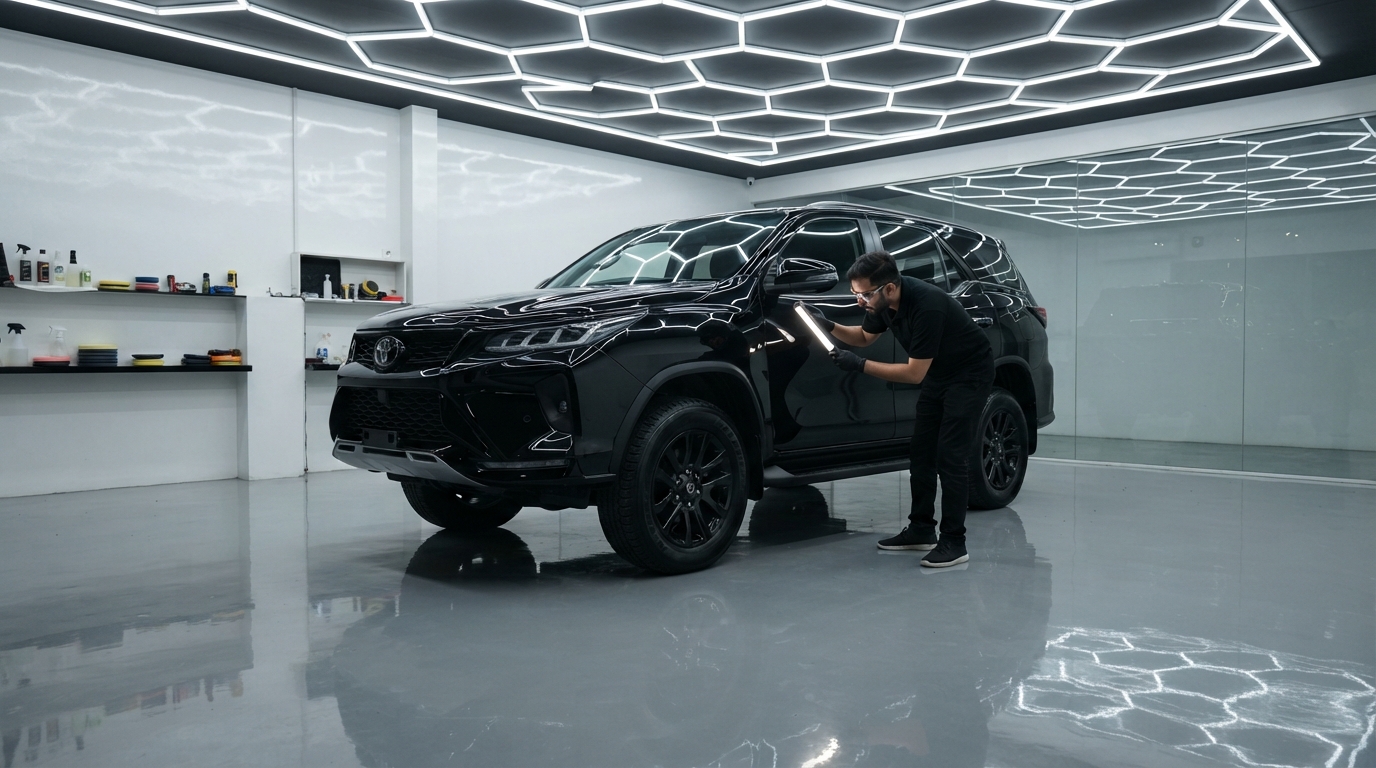
You pull a factory-fresh Phantom Black Toyota Fortuner Legender out of the showroom, pay a significant registration invoice, and point the nose down the highway. Cruising at 120 km/h behind traffic, you hear that gut-wrenching clack-tick sound against the front bumper.
When you pull into a rest stop, your heart sinks. The soft factory waterborne clear coat on the aggressive front snout has yielded: pinhead-sized craters exposing bare plastic and undercoat. On dark metallic paints, high-speed road projectiles leave unmistakable scars.
This brings serious vehicle owners to a crucial crossroad: do you wrap the vehicle in computer-cut Aliphatic Thermoplastic Polyurethane (TPU) film, or do you apply an elastomeric Peelable Paint Protection Spray (PPS / Liquid PPF)?
> Quick Verdict / Key Takeaway: > For high-energy kinetic rock chip impacts on flat panels, 8-mil Aliphatic TPU film remains the gold standard in tensile energy absorption. However, on vehicles with intricate 3D grilles, aggressive aero fins, and complex bumper curves, Peelable Paint Protection Spray (PPS) offers an entirely seamless, factory-finish barrier without relief cuts, stretch lines, or lifting edges.
The Paintwork Reality: Clear Coat Microns and Environmental Stress
To understand why modern factory paint chips so easily, we inspect vehicles using digital electromagnetic paint depth gauges.
Typical Factory Multi-Layer Paint Structure
| Paint Layer | Function & Composition | Typical Thickness (Microns) | Mohs Hardness Rating |
|---|---|---|---|
| Sacrificial Clear Coat | UV blockers, acrylic-melamine resin gloss | 25 – 35 µm | 2H – 3H (Soft) |
| Color Basecoat | Automotive pigment & metallic pearl flake | 15 – 20 µm | N/A |
| Primer / Surfacer | Leveling substrate & stone impact cushion | 25 – 30 µm | 3H – 4H |
| Cathodic E-Coat | Anti-corrosion electrodeposition dip | 15 – 20 µm | 4H – 5H |
| Vehicle Substrate | Galvannealed steel / ABS composite fascia | Base Bodywork | Substrate |
Total paint depth on locally assembled and imported Japanese SUVs measures between 95 and 115 microns. Your sacrificial clear coat layer—the sole defense against oxidation, acid rain, bird lime, and surface abrasion—is roughly 30 microns thick (thinner than a standard sheet of paper).
On the Mohs scale, clear coat registers around 2H to 3H. Airborne gravel and crushed stone kicked up on highways consist of quartz and granite particles registering at 6H to 7H on the Mohs scale. When high-velocity aggregate strikes a 30-micron clear coat, physics takes over: the unprotected paint fractures down to the primer or plastic substrate.
Technical Comparison: Peelable Spray vs. TPU Film
Both systems are engineered to protect your vehicle, but their chemistry, installation methods, and mechanical properties differ fundamentally.
| Feature / Specification | Peelable Paint Protection Spray (Liquid PPF) | Extruded Aliphatic TPU Film |
|---|---|---|
| Primary Chemical Composition | High-solids aliphatic polyurethane liquid | Polycaprolactone-based Aliphatic TPU |
| Installed Thickness | 160 – 220 microns (6.5 – 8.5 mils) | 190 – 215 microns (7.5 – 8.5 mils) |
| Tensile Strength | 22 – 28 MPa | 32 – 42 MPa |
| Elongation at Break | 350% – 450% | 400% – 550% |
| Kinetic Impact Absorption | High (Disperses energy evenly across panel) | Maximum (Dense polymer lattice absorbs projectile) |
| Installation Method | Multi-coat HVLP spray gun application | Wet slip-and-tack squeegee application |
| Coverage Profile | 100% seamless; covers 3D grilles, badges, vents | Requires edge wrapping, relief cuts on deep curves |
| Self-Healing Ability | Moderate to High (Thermal recovery at 60°C) | Instantaneous to Heat-Activated (50°C) |
| Chemical Resistance | pH 2 to pH 12 | pH 2 to pH 12 |
| Orange Peel / Texture | Zero (Can be wet-sanded and flat-polished) | Varies (High-grade TPU mimics OEM glass finish) |
| Lifespan in Pakistan Climate | 3 to 5 Years | 5 to 7+ Years (Reputable brands) |
| Average Full Body PKR Cost | PKR 380,000 – PKR 520,000 | PKR 480,000 – PKR 750,000 |
Kinetic Impact Breakdown: Choosing the Right Protection
- Extruded Aliphatic TPU: Features crosslinked, high-density polymer chains backed by pressure-sensitive acrylic adhesive (PSA). When struck, the top coat temporarily deforms, absorbing kinetic energy and distributing it across the resilient urethane core before rebounding. For severe stone chips on flat panels, TPU is the industry benchmark.
- Peelable Spray (PPS): Creates an uninterrupted protective shell. Because it is sprayed as an atomized liquid, it enters microscopic recesses that film sheets must bridge or trim around. It shields every angle of complex front grilles without relief slits, deflecting standard road gravel scatter.
Realistic Market Investment & Pricing in Pakistan
| Protection Tier | Material Specification | Realistic Price Range (Full SUV) | Clear Coat Safety Profile |
|---|---|---|---|
| 1. Premium Aliphatic TPU | XPEL, STEK, SunTek, or genuine OEM supply | PKR 480,000 – PKR 750,000 | 100% Safe (Clean release adhesive) |
| 2. Quality Peelable Spray (PPS) | Ngenco, ClarityCoat, Protek elastomeric | PKR 380,000 – PKR 520,000 | 100% Safe (Peelable zero-damage layer) |
| 3. Counterfeit TPH / PVC Vinyl | Monomeric PVC / plasticized wrap | PKR 140,000 – PKR 220,000 | Extreme Risk: Will bake & strip clear coat |
The TPH and PVC Counterfeit Warning
If a workshop quotes you PKR 150,000 to PKR 200,000 for a full SUV "TPU PPF", proceed with extreme caution.
At that price, the material being installed is almost certainly TPH (plasticized PVC). Under intense UV radiation and heat, cheap plasticizers evaporate. The film oxidizes, turns an unsightly yellow, cracks, and bakes permanently into the vehicle's clear coat. When attempting removal, aggressive industrial glue lifts patches of factory clear coat directly off bumpers and hoods.
Cleanroom Application Workflow Protocol
Achieving an optical, durable finish requires a strictly controlled environment. Below are the 5 professional stages executed inside our climate-controlled cleanroom studio:
- 1Stage 1: Multi-Stage Decontamination
- High-pressure deionized rinse and pH-neutral citrus pre-wash to lift road film without etching.
- Chemical iron fallout removal on lower panels and brake calipers.
- Synthetic clay bar glide with dedicated polymer lubricant.
- 2Stage 2: Precision Paint Correction & Jeweling
- Rotary compounding to remove factory micro-scratches and orange peel defects.
- Dual-Action finishing polish to restore maximum paint clarity and metallic depth.
- Panel wipe using 70/30 Isopropyl Alcohol (IPA) to strip all polishing oils.
- 3Stage 3: Masking & Cleanroom Preparation
- High-temp precision edge masking of weatherstripping, rubber gaskets, and headlights.
- Electrostatic blowdown inside cleanroom to remove all airborne dust particulates.
- 4Stage 4: Application Process
- For TPU Film: Wet slip application, tension anchoring, squeegee fluid evacuation, and 360-degree edge wrapping.
- For Peelable Spray: Adhesion promoter base, 4 build coats of elastomeric polymer, and 2 high-gloss polyurethane clear coats with flash-off intervals.
- 5Stage 5: Curing & Quality Control
- Edge post-heating to 90°C for film memory setting.
- Short-wave Infrared (IR) curing banks for spray coats.
- 24-hour curing cycle in climate-controlled bay prior to vehicle release.
Proper Washing & Maintenance Protocol
1. The Two-Bucket Wash Routine
- Bucket 1 (Clean Rinse): Used exclusively to rinse and agitate the wash mitt against a Grit Guard after every panel pass.
- Bucket 2 (Shampoo): Filled with soft/filtered water mixed with a pH-neutral automotive shampoo.
- Always wash from top to bottom, keeping lower rocker panels and wheel arches for the final step.
2. Avoiding Harmful Chemicals & Abrasives
- Avoid roadside service stations using untreated high-TDS bore water under direct sunlight.
- Never use dishwashing detergents, harsh degreasers, or oily silicone engine dressings that attract abrasive grit.
Frequently Asked Questions (FAQs)
Will removing peelable spray or TPU film damage my factory paint?
No, provided the vehicle carries original factory-baked paintwork and the film is genuine aliphatic TPU or professional peelable spray. Factory paint is oven-cured at 140°C+, forming a durable bond. However, if a panel has been repainted locally with air-dried clear coat, inform your installer beforehand.
Why not just apply a ceramic coating instead of film or spray?
A ceramic coating is an ultra-thin liquid glass layer (0.5 to 1.5 microns) designed for chemical resistance, UV protection, hydrophobicity, and gloss. It has virtually no kinetic shock absorption. A sharp highway stone will penetrate a ceramic coating instantly. Ceramic coatings protect against chemical etching; film and spray stop physical stone chips.
How can I spot fake TPH film in the market?
- The Stretch Test: Genuine TPU stretches cleanly and recovers under mild heat. TPH stretches with high resistance, discolors, and leaves cloudy white stretch lines.
- The Burn Test: Real TPU burns cleanly with minimal smoke and a faint paraffin scent. PVC/TPH burns with black soot and an acrid, sharp chemical chlorine smell.
Can Peelable Paint Protection Spray be polished if scratched?
Yes. Professional PPS creates a thick elastomeric clear coat that can be wet-sanded with 3000-grit paper and machine-polished with standard dual-action compounds to restore optical gloss.
> Related Master Guide: For an authoritative technical deep-dive into this subject, read our clinical analysis on Front-End PPF: Is Partial Paint Protection Film Worth the Cost?.
> Related Master Guide: For an authoritative technical deep-dive into this subject, read our clinical analysis on Is PCU Film Worth the Extra Cost Over Standard TPU?.
> Related Master Guide: For an authoritative technical deep-dive into this subject, read our clinical analysis on Why Cheap PPF Turns Yellow and Damages Clear Coat.
> Related Master Guide: For an authoritative technical deep-dive into this subject, read our clinical analysis on The Meguiar's 5-Step Paint Care Guide for Daily Drivers.