
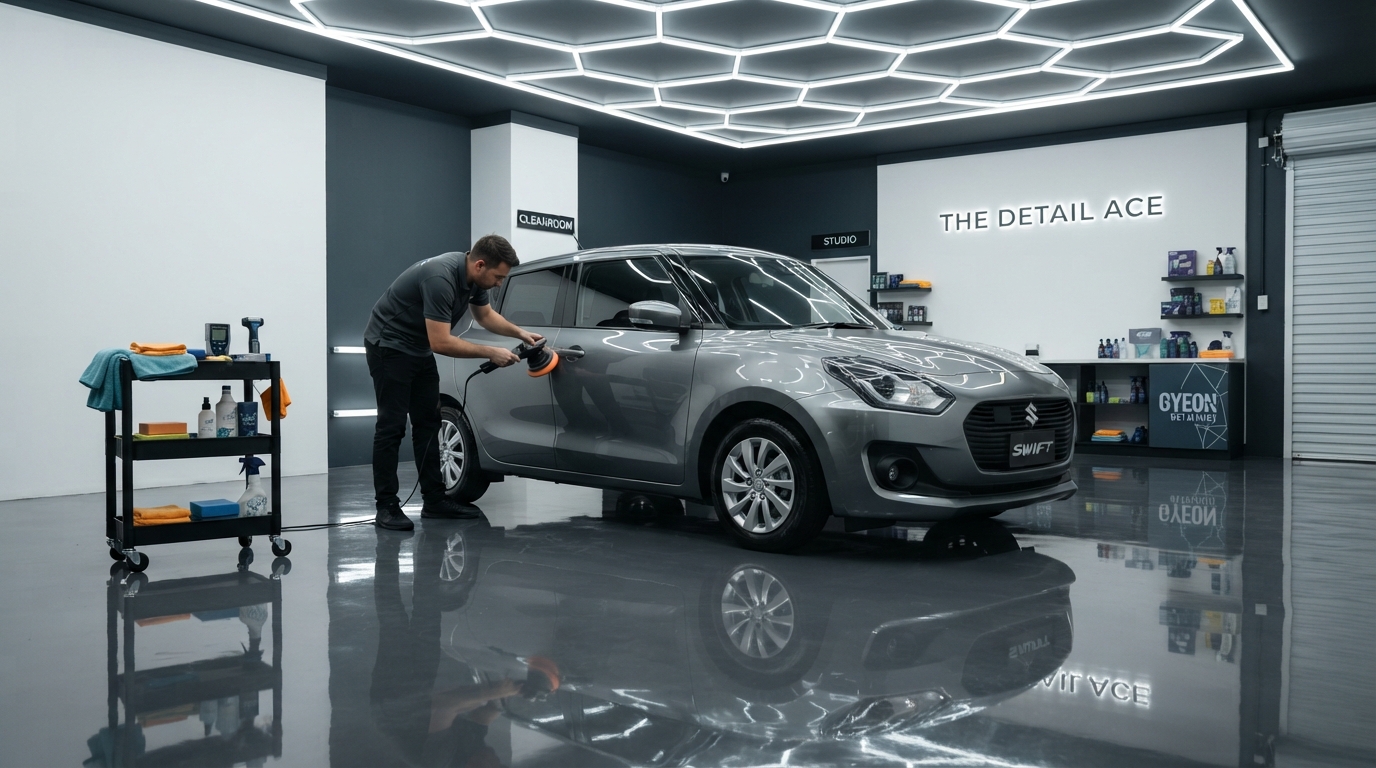
> Quick Takeaway (TL;DR): The Meguiar's 5-Step Paint Care Guide for Daily Drivers provides an engineered system—Washing, Surface Prep, Polishing, Protection, and Maintenance—to preserve soft factory clear coats (28–35 microns) against tubewell bore water calcium etching and swirl marks. Professional execution at The Detail Ace costs PKR 22,000 to PKR 48,000.
Clear Coat Physics & Paint Substrate Engineering
The factory paint finish on the Swift GLX CVT (Mineral Grey) features a total dry film thickness (DFT) ranging between 85 and 110 microns. The top clear coat layer comprises merely 28 to 35 microns of soft, organic acrylic polyurethane resin, registering approximately 2H to 3H on the pencil hardness scale. This low surface hardness makes the Mineral Grey metallic substrate vulnerable to micro-marring, spiderweb scratches, and wash-induced friction marring.
Mineral Grey features concentrated mica and aluminum flake pigmentation suspended within the base coat. When light passes through an uncorrected clear coat damaged by sub-surface abrasions, reflection scatters, which degrades optical clarity and dulls the metallic flake pop. Furthermore, high ambient temperatures accelerate the cross-linking of environmental fallout and airborne industrial particulates directly into the resin matrix.
Local tap and ground sources contain heavy calcium carbonate, magnesium salts, and mineral silicates. When deposited on untreated panels under direct UV exposure, this tubewell bore water creates severe calcium etching. The Meguiar's 5-step paint restoration protocol systematically strips bonded contaminants, levels micro-defects with non-diminishing micro-abrasives, and establishes a hydrophobic barrier without depleting vital clear coat thickness.
Comparative Detailing Performance Specifications
| Metric / Specification | Untreated Hand Washing | Meguiar's 5-Step Daily Protocol | Studio Multi-Stage Corrective System |
|---|---|---|---|
| Clear Coat Consumption | 0.0 microns (creates deep scratches) | 0.5 – 1.2 microns (via DA polisher) | 2.0 – 4.0 microns (corrective cut) |
| Defect Elimination Rate | 0% (masks or induces marring) | 70% – 85% swirl & haze removal | 92% – 98% complete defect extraction |
| Water Contact Angle | < 45° (sheeting, highly prone to spots) | 95° – 102° (hydrophobic polymer bead) | 110° – 118° (superhydrophobic quartz) |
| Chemical Resistance | pH 6.5 – pH 7.5 | pH 4.0 – pH 10.0 | pH 2.0 – pH 13.0 |
| Thermal Durability | Nil (degrades under 40°C) | Up to 80°C surface temperature | Exceeds 300°C surface temperature |
| Target Service Interval | None (daily degradation) | Every 3 to 4 months | Every 24 to 36 months |
The Meguiar's 5-Step Paint Care Guide for Daily Drivers: Actionable Workflow
#### Stage 1: Washing (pH-Neutral Two-Bucket Method) Rinse the Swift GLX CVT under high-pressure water (110–130 bar) to blow off loose grit and top-layer road film without mechanical contact. Prepare two buckets fitted with grit guards: one containing Meguiar's Gold Class Car Wash mixed at 30 ml per 4 liters of filtered water, and the second bucket with clean rinse water.
Wash from the upper roof panels downward using a micro-chenille wash mitt, dunking and scrubbing the mitt against the bottom grit guard after every single panel. Rinse the vehicle thoroughly with low-mineral water and dry using a 1200 GSM twisted-loop microfiber towel lubricated with a light mist of quick detailer to eliminate friction drag.
#### Stage 2: Surface Preparation & Mechanical Decontamination Inspect the dried Mineral Grey clear coat for embedded industrial iron fallout, tree sap, and tubewell bore water calcium etching. Mist Meguiar's Quik Detailer or a dedicated clay lubricant generously across a 2x2 foot section, then glide Meguiar's Smooth Surface Clay Bar across the surface in overlapping cross-hatch motions until the drag disappears.
For moderate swirl marks and spiderweb scratches, mount a yellow foam polishing pad onto a Dual-Action (DA) polisher set between 4,800 and 5,800 OPM. Apply four pea-sized drops of Meguiar's Ultimate Compound (or German Koch-Chemie F6 Medium Cut for deeper scratches), working the section under moderate downward pressure to level the damaged clear coat without creating buffer trails. Wipe away compound residue with a 350 GSM edgeless microfiber towel.
#### Stage 3: Machine Polishing for Depth & Clarity Polishing is an essential step on Mineral Grey paint to saturate the base coat with rich conditioning oils and eliminate compounding haze. Mount a black soft-finishing foam pad to the DA polisher, set the tool speed to 3,800 OPM, and apply Meguiar's Ultimate Polish or Koch-Chemie M3 Micro Cut.
Work the product in tight horizontal and vertical passes using light machine weight, allowing the micro-abrasives to clear the paint finish to a razor-sharp reflection. This step restores true optical clarity to the clear coat, ensuring the underlying metallic flake reflects sun and artificial street lighting at peak intensity.
#### Stage 4: Hydrophobic Surface Protection Lock in the polished finish by applying a durable chemical barrier against local road grime, acid rain, and environmental oxidation. Dispense Meguiar's Ultimate Liquid Wax (a pure synthetic polymer sealant) onto an ergonomic foam applicator pad or a finishing DA foam pad run at low speed (2,500 OPM).
Spread an ultra-thin, even layer across all exterior painted surfaces, avoiding textured black plastics. Allow the synthetic polymers to cure for 10 to 15 minutes until it passes the finger-swipe test (a clear, non-greasy swipe). Buff the haze off with a clean, plush 450 GSM microfiber towel to leave behind a slick, highly hydrophobic film.
#### Stage 5: Preventative Maintenance & Calibrated Upkeep Sustain the hydrophobic layer and prevent hard water adhesion between weekly washes by utilizing Meguiar's Ultimate Quik Detailer. The specialized hydrophobic polymer chemistry boosts surface tension, forcing rinse water and airborne dew to bead up and roll off without mineral spotting.
Keep an emergency bottle of detailer and a clean 500 GSM microfiber towel inside the vehicle. Instantly spot-clean fresh bird droppings, tree sap, and water spots before ambient heat bakes their corrosive acids into the vulnerable 30-micron clear coat.
Advanced Studio Upgrades: GYEON Quartz & TPU Film Integration
While the standard Meguiar's 5-step maintenance routine keeps daily drivers looking pristine, daily commuting through industrial zones and loose gravel demands advanced physical and chemical barriers:
- Ceramic Quartz Systems: For car owners wanting chemical protection without regular wax reapplication, The Detail Ace installs GYEON quartz coatings (CanCoat Pro, Mohs, or multi-layer Syncro). These formulas bond directly to the clear coat, forming an inorganic siloxane matrix rated at 9H pencil hardness that shields against harsh pH 2 to 13 chemicals.
- Paint Protection Film (PPF): High-impact zones (front bumper, hood, side mirrors, rocker panels) on the Swift GLX CVT are prone to rock chips. The Detail Ace applies strictly 7.5 mil and 8.5 mil TPU aliphatic polyurethane films featuring self-healing elastomeric topcoats that withstand high-speed debris strikes.
- Chassis & Underbody Armor: Commuting through road construction and standing water accelerates rust on bare stamped metal. We apply HB Body U-100 Rubberized stone chip shield to underbody wells, floor pans, and pinch welds to provide superior acoustic damping and stone-chip protection.
Frequently Asked Questions
#### Can Meguiar's Ultimate Compound thin the factory clear coat on a Swift GLX CVT? No, when applied with a dual-action (DA) polisher and a foam pad, Meguiar's Ultimate Compound utilizes sub-micron, non-diminishing abrasives that remove only 0.5 to 1.2 microns of clear coat per full pass. This leaves over 95% of your factory 28–35 micron clear coat intact, making it completely safe for regular defect removal on modern thin-paint daily drivers.
#### How does this 5-step workflow counter tubewell bore water calcium etching? Step 2 (surface preparation) mechanically levels out the hard mineral rings using clay and micro-abrasive compounding, while Step 4 (synthetic polymer sealing) forms an impenetrable hydrophobic barrier. This elevated surface tension prevents hard water droplets from flattening, ensuring they bead up and roll off before ambient heat can deposit alkaline mineral salts into the clear coat resin.
#### How frequently should this 5-step workflow be repeated on a daily driver? Steps 1 and 5 (washing and quick detailer maintenance) should be conducted weekly or bi-weekly depending on environmental exposure. Steps 2, 3, and 4 (clay decontamination, light polishing, and polymer wax protection) should be executed every 3 to 4 months to prevent micro-scratch build-up and maintain continuous UV oxidation protection on the finish.
#### When should I upgrade from Meguiar's wax to 7.5 mil or 8.5 mil TPU PPF? If your daily commute includes high-speed bypasses, bypass bypasses, or gravel-heavy roads, liquid waxes cannot prevent physical stone impacts or rock chipping. Upgrading to a 7.5 mil or 8.5 mil TPU film at The Detail Ace delivers a physical urethane shock absorber that permanently stops paint chips, swirl marks, and scratches with self-healing surface technology.
> Related Master Guide: For an authoritative technical deep-dive into this subject, read our clinical analysis on Meguiar's Ultimate Compound vs Ultimate Polish: Which Does Your Paint Need?.