
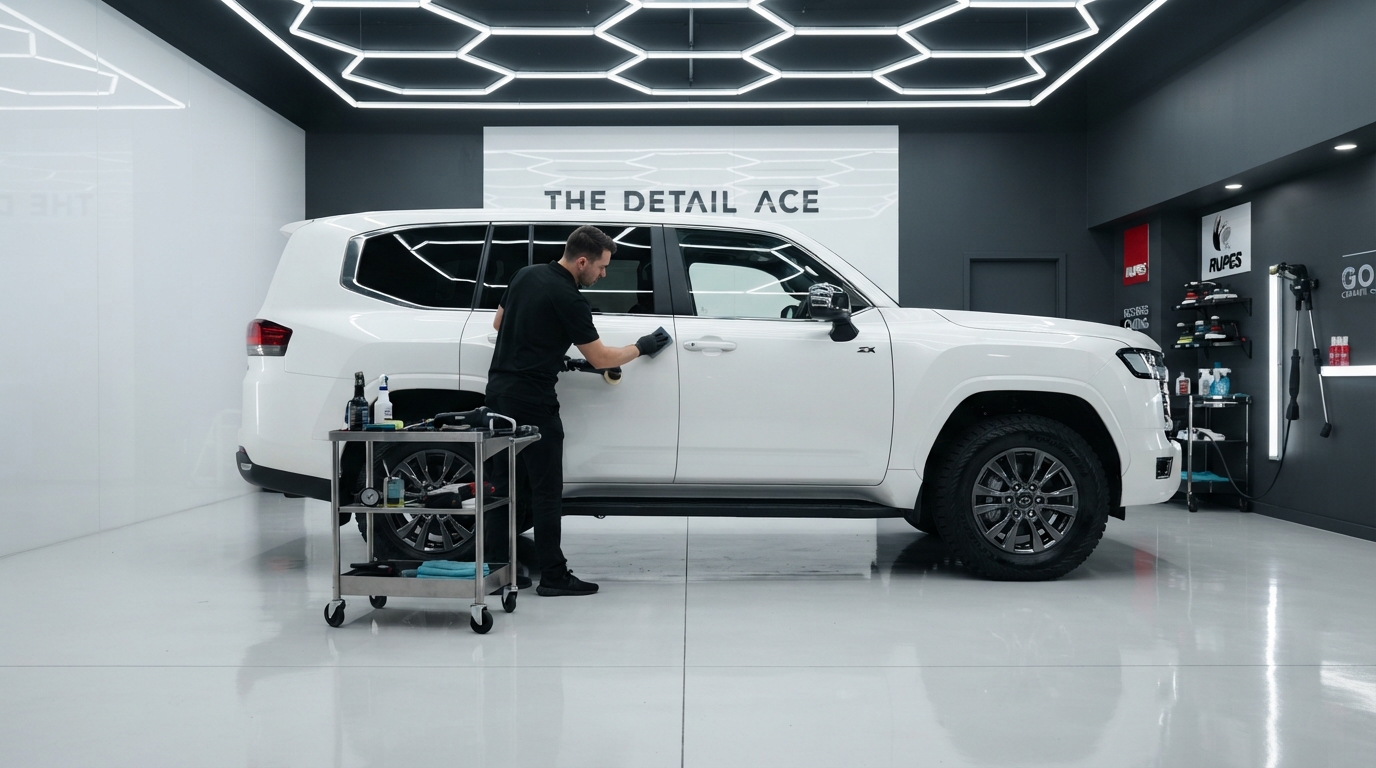
> Quick Takeaway (TL;DR): PCU (Polycarbonate Polyurethane) film is unequivocally worth its 25% to 35% cost premium over standard 7.5 mil or 8.5 mil TPU for high-value vehicles like the Pearl White Toyota Land Cruiser LC300. Engineered with a polycarbonate-modified backbone, PCU delivers higher tensile strength, zero-orange-peel optical clarity, and unmatched resistance against tubewell bore water calcium etching and UV yellowing.
Technical Analysis: PCU vs. TPU Polymer Engineering
Thermoplastic Polyurethane (TPU) has served as the benchmark substrate for automotive paint protection film for over a decade. Premium TPU consists of an aliphatic polycaprolactone or polyether diol core that provides elastomeric flexibility, low-temperature resilience, and thermal self-healing capabilities. While standard 7.5 mil and heavy-duty 8.5 mil TPU films offer strong kinetic impact absorption, their softer molecular matrix remains inherently vulnerable to sustained chemical hydrolysis, organic staining, and microscopic surface deformation.
Polycarbonate Polyurethane (PCU) represents the next generational leap in film synthesis. By replacing or hybridizing standard polyols with aliphatic polycarbonate diols, chemical engineers achieve a significantly higher cross-link density within the polymer backbone. This polycarbonate integration yields an exceptionally dense molecular structure that increases surface tension and mechanical shear resistance without compromising structural ductility.
| Polymer Matrix Architecture | Molecular Backbone Composition | Environmental Defense Profile |
|---|---|---|
| Standard TPU Matrix | Flexible Polyether / Caprolactone Diols | Porous to aggressive acids, road salts, and chemical alkalis |
| PCU Hybrid Matrix | Polycarbonate-Reinforced Dense Cross-Links | Dense impermeable barrier against UV radiation and chemical leaching |
For a vehicle with substantial frontal surface area like the Toyota Land Cruiser LC300, clear coat defense requires high tensile modulus. The LC300 leaves the factory with an average total paint depth of 115 to 135 microns, of which the factory clear coat accounts for merely 35 to 45 microns. Standard TPU cushions mechanical stone strikes via high elongation, but PCU redistributes kinetic energy across a rigid-yet-elastic polycarbonate lattice, preventing deep stone chip indentations from bottoming out into the primer.
Chemically, PCU exhibits near-total impermeability across a broad pH spectrum (pH 1 through pH 14). Standard TPU top-coats degrade when subjected to localized acidic fallout or heavy alkaline cleaners, causing microscopic pores to open and collect airborne pollutants. PCU's non-porous surface structure prevents foreign particle ingress, eliminating the dulling, micro-clouding, and loss of gloss commonly seen on older TPU installations.
Comparative Specification Matrix
| Engineering Metric | Standard 7.5 mil TPU | Heavy-Duty 8.5 mil TPU | Next-Gen PCU Film |
|---|---|---|---|
| Base Polymer Chemistry | Aliphatic Polycaprolactone TPU | Aliphatic Polyether TPU | Polycarbonate-Polyurethane Hybrid |
| Total Thickness (with Cap Sheet) | 7.5 mil (190.5 microns) | 8.5 mil (215.9 microns) | 8.5 to 9.0 mil (215 to 228 microns) |
| Top-Coat Hardness Rating | 2H – 3H | 3H | 4H – 5H |
| Tensile Strength (MPa) | 35 – 42 MPa | 40 – 48 MPa | 58 – 65 MPa |
| Elongation at Break | 350% – 420% | 380% – 450% | 280% – 340% |
| Hydrophobic Contact Angle | 98° – 102° | 100° – 105° | 110° – 116° |
| Chemical & pH Resistance | pH 4.0 – 10.0 | pH 3.5 – 11.0 | pH 1.0 – 14.0 |
| Tubewell Water Etch Resistance | Moderate (Susceptible < 48 hrs) | Moderate (Susceptible < 72 hrs) | Extreme (Impervious to calcification) |
| Optical Clarity (Orange Peel) | Noticeable Texture Distortion | Mild Texture Distortion | Near-Zero Orange Peel (Optically Pure) |
| UV Yellowing Index (\Delta YI) | < 1.5 over 3 years | < 1.2 over 5 years | < 0.3 over 7+ years |
| Relative Investment Delta | Baseline Cost | +12% to +18% over 7.5 mil | +25% to +35% over 8.5 mil TPU |
The Pearl White LC300: Why Film Chemistry Dictates Aesthetics
The Toyota Land Cruiser LC300 finished in 070 Pearl White (White Pearl Crystal Shine) or 090 Precious White Pearl poses distinct optical and chemical challenges. Three-stage pearl paints utilize a base coat, a semi-translucent mica flake mid-coat, and an organic clear coat. When standard TPU begins to degrade, photo-oxidation causes yellowing that is immediately obvious against the bright white mica backdrop, creating a muddy, discolored finish.
| Substrate Technology | UV Radiation Exposure Mechanism | 7-Year Optical Clarity Outcome |
|---|---|---|
| Standard TPU Film | Photo-oxidation activates trace aromatic impurities | Surface yellowing, haze, and loss of clarity on white mica flake |
| PCU Hybrid Substrate | High-density cross-links reject photo-oxidation | Remains 100% optically pure crystal white (\Delta YI < 0.3) |
Tubewell bore water calcium etching represents another major hazard for Pakistani vehicle owners. Bore water characterized by total dissolved solids (TDS) exceeding 800 to 1,200 ppm deposits calcium carbonate, magnesium sulfate, and heavy mineral salts onto the paintwork. Under sustained ambient temperatures exceeding 42°C, these mineral deposits rapidly bake into the surface, causing severe water spots that standard TPU top-coats absorb into their pores.
Remediating etched TPU often requires aggressive machine correction or complete panel replacement. PCU films resolve this failure mode entirely: their dense polycarbonate surface cross-linking prevents mineral ions from penetrating the clear coat barrier. Calcium deposits rest entirely on the hydrophobic surface, where they can be chemically stripped during maintenance washes without degrading the underlying film.
Installation & Surface Preparation Protocol: The Detail Ace Standard
Applying PCU film to an LC300 requires precise environmental control and technical surface preparation. Because PCU features higher tensile stiffness than 7.5 mil TPU, cleanroom surface prep and panel matching are critical to preventing installation lift lines or edge failures.
| Stage Sequence | Cleanroom Detailing Milestone | Technical Objective & Specification |
|---|---|---|
| 01 | Decontamination Wash | pH-neutral foam soak, iron fallout removal & citrus tar strip |
| 02 | Paint Depth Mapping | Ultrasonic gauge profiling across factory clear coat (35–45 µm) |
| 03 | Multi-Stage Compounding | German Koch-Chemie 3-step paint correction (H9 → F6 → M3) |
| 04 | Solvent IPA Strip | 25% IPA wipe to dissolve all residual oils and guarantee PSA tack |
| 05 | PCU Installation | Positive-pressure 22°C cleanroom fitment with 8–12mm edge tucking |
| 06 | Quartz & Chassis Shield | GYEON CanCoat Pro surface seal + HB Body U-100 wheel arch armor |
Stage 1: Multi-Stage Decontamination
- 1Submerge lower rocker panels and front bumpers in a high-lubricity pH-neutral foam to lift heavy road grime.
- 2Chemically dissolve embedded ferrous brake particulates using a dedicated acid-free iron fallout remover.
- 3Treat traffic film and lower-body road tar with an organic citrus tar solvent.
- 4Manually decontaminate the clear coat using an ultra-fine clay mitt with dedicated synthetic clay lubricant to remove remaining surface grit.
Stage 2: Paint Thickness Gauge Mapping & Machine Paint Correction
- 1Measure panel depths across all metal surfaces using an electromagnetic paint thickness gauge to verify the factory clear coat profile (35 to 45 microns).
- 2Mount a heavy-cut wool pad onto a rotary polisher paired with German Koch-Chemie H9 Heavy Cut compound to eliminate deep factory defects, wet sanding pigtails, and transit scratches.
- 3Switch to a dual-action (DA) polisher paired with a medium-density foam pad and Koch-Chemie F6 Medium Cut to remove compounding haze and eradicate swirl marks and spiderweb scratches.
- 4Complete the refinement stage using a soft finishing foam pad on a DA polisher charged with Koch-Chemie M3 Micro Cut to bring the LC300's Pearl White paint to a crystal-clear, high gloss finish.
Stage 3: Isopropyl Alcohol (IPA) / Surface Prep Stripping
- 1Spray the entire vehicle with a dedicated alcohol-based panel wipe solution (20% to 30% IPA/solvent blend).
- 2Wipe panels down using split-weave edgeless microfiber towels to dissolve residual polishing oils, lubricants, and fillers, ensuring direct chemical adhesion between the paint and the film's pressure-sensitive adhesive (PSA).
Stage 4: Cleanroom Edge-Wrapped PCU Installation
- 1Position the LC300 inside a climate-controlled, positive-pressure cleanroom operating at 22°C to 24°C and 50% relative humidity to prevent airborne dust contamination.
- 2Apply precision-plotted PCU templates designed with an extra 8mm to 12mm of material along every panel edge.
- 3Squeegee the film using an ergonomic multi-durometer polyurethane blade, working outward from center bodylines using an isopropyl alcohol-and-water slip-solution mixture.
- 4Wrap all film edges around inner panel seams, door returns, and fender recesses, post-heating every edge to 85°C with a digital heat gun to permanently lock the polymer memory.
Stage 5: Synergistic Coating & Chassis Armor
- 1Apply GYEON quartz Mohs or Syncro quartz coatings over all exposed unfilmed structural trims, rear emblems, and engine bay cowls for uniform chemical defense.
- 2Coat the entire PCU film surface with GYEON quartz CanCoat Pro to impart hyper-slickness, bringing the surface contact angle past 110° and boosting its self-cleaning capability.
- 3Coat inner wheel well liners and exposed chassis components with HB Body U-100 Rubberized stone chip shield to protect the running gear and fender wells against heavy stone throw and gravel erosion.
Post-Installation Maintenance Protocol
Maintaining PCU on an LC300 requires structured washing practices to preserve its self-healing top-coat and optical clarity:
- Two-Bucket Wash with Grit Guards: Always wash using two separate buckets—one for clean shampoo solution and one fitted with dual grit guards to rinse out abrasive road grit.
- Tubewell Water Avoidance: Never wash the vehicle in direct midday sunlight using untreated, hard tubewell bore water. If bore water is used, rinse immediately with deionized water or blow-dry using filtered, touchless warm air.
- Dedicated Shampoos: Use pure, pH-neutral maintenance shampoos free of added carnauba waxes, silicones, or gloss-enhancing polymers that could clog the PCU top-coat.
- Chemical Decontamination Intervals: Every four to six months, perform a specialized chemical decontamination wash to dissolve trace calcium buildup and fallout from the film pores, followed by an application of GYEON quartz CanCoat Pro to restore peak water beading.
The Verdict: Is PCU Worth the Investment?
For an entry-level commuter or fleet vehicle, a standard 7.5 mil or 8.5 mil TPU film provides adequate paint protection at a lower upfront cost. However, for a flagship vehicle like the Toyota Land Cruiser LC300 in Pearl White, standard TPU represents an aesthetic and functional compromise.
The upfront cost increase of 25% to 35% for PCU is directly offset by three factors: it eliminates the need for premature film replacement caused by UV yellowing, prevents tubewell bore water calcium etching from permanently marking the vehicle, and preserves the cleanroom-corrected clear coat beneath an optically pure, orange-peel-free barrier. When preserving maximum residual value, optical clarity, and absolute defense against harsh environmental contamination, PCU film delivers a definitive return on investment.
High-Intent Frequently Asked Questions
Does PCU film prevent yellowing on Pearl White Toyota LC300 paint?
Yes. PCU's aliphatic polycarbonate backbone contains stronger molecular bonds than conventional TPU, drastically reducing degradation from high ultraviolet radiation. While standard TPU can show measurable color shift (\Delta YI > 1.5) within three years on white paint, PCU maintains optical clarity with a yellowing index below 0.3 over seven years.
Can PCU film self-heal swirl marks and spiderweb scratches like TPU?
Yes. PCU features an advanced elastomeric memory top-coat that heals light wash swirls and spiderweb scratches when exposed to direct sunlight or warm water (above 60°C). Because its cross-link density is higher than standard TPU, the top-coat is more scratch-resistant overall, meaning it accumulates fewer surface abrasions during routine maintenance washes.
Why not simply install a thicker 8.5 mil TPU film instead of PCU?
While 8.5 mil TPU offers thick mechanical absorption, thickness alone does not prevent chemical etching or UV degradation. Heavy-duty 8.5 mil TPU still utilizes standard polyols that remain susceptible to tubewell bore water calcium etching, road grime staining, and optical orange peel distortion. PCU provides superior tensile resistance and surface hardness in an optically pure substrate that will not haze or yellow.
How does tubewell bore water damage PPF, and how does PCU stop it?
Tubewell bore water contains high concentrations of dissolved minerals like calcium and magnesium that precipitate onto vehicle panels as the water evaporates. On standard TPU, these minerals physically etch into the soft top-coat under high ambient heat, requiring aggressive polishing to remove. PCU's cross-linked polycarbonate construction creates an impenetrable barrier, preventing mineral ions from embedding so they can be washed away with a mild acidic descaling wash without damaging the film.