
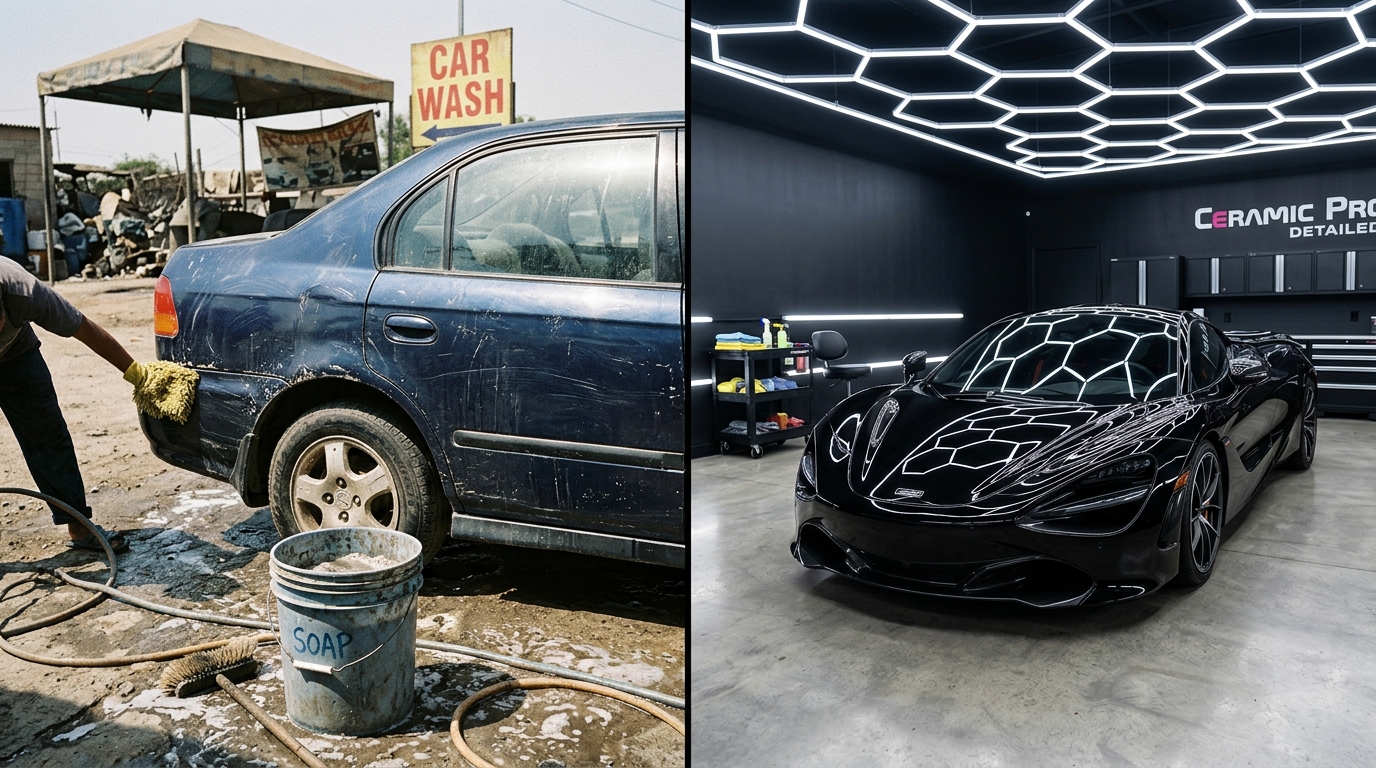
Many car owners use the terms "Car Wash" and "Car Detailing" interchangeably. However, they represent two completely different levels of automotive maintenance. While a car wash is designed for a quick surface rinse, professional car detailing is a restorative, meticulous craft that preserves your vehicle's structural and aesthetic health.
At The Detailing Ace, we break down the fundamental differences between these two services and explain why professional detailing is essential for protecting your vehicle's long-term value.
1. What is a Standard Car Wash?
A standard car wash is a routine, fast maintenance process intended primarily to remove loose surface dirt, mud, and road grime from the exterior of a vehicle.
Common Car Wash Characteristics:
- Duration: Typically takes 15 to 30 minutes.
- Equipment: High-volume pressure washers, automated spinning brushes, and generic wash buckets.
- Scope: Basic exterior foam, rinse, wheel wipe, and topical interior vacuuming.
- Limitations: Does not remove embedded clear coat contaminants (iron fallout, industrial pollution), does not correct scratches, and provides minimal paint protection.
2. What is Professional Car Detailing?
Automotive detailing is an in-depth, precision restoration process that meticulously cleans, decontaminates, corrects, and protects every square inch of a vehicle from bumper to bumper.
Detailing Core Operations:
- 1Multi-Stage Decontamination: Chemical iron fallout dissolution, tar removal, and clay bar mechanical decontamination.
- 2Paint Inspection & Depth Measurement: Measuring clear coat thickness in microns with digital ultrasonic gauges before machine work.
- 3Precision Paint Correction: Machine polishing using rotary and dual-action polishers to permanently eliminate swirl marks, scratches, and oxidation.
- 4Deep Interior Extraction: Hot-water bio-steam extraction for cloth seats, leather conditioning, AC vent disinfection, and ozone sanitization.
- 5Durable Surface Sealing: Long-term protection via nano-ceramic coatings, synthetic polymer sealants, or Paint Protection Film (PPF).
3. Side-by-Side Comparison: Car Wash vs. Car Detailing
| Feature / Aspect | Standard Car Wash | Professional Car Detailing |
|---|---|---|
| Primary Goal | Fast topical dirt removal | Restorative cleaning, paint correction & protection |
| Time Required | 15 – 30 Minutes | 1 to 3 Full Days |
| Swirl Mark Prevention | High risk of swirls (dirty rags/brushes) | Zero-swirl two-bucket & cleanroom methodology |
| Paint Decontamination | None | Full chemical iron removal & clay bar leveling |
| Paint Correction | None | Multi-stage machine jeweling & swirl removal |
| Interior Deep Clean | Quick surface vacuum pass | Steam extraction, stain removal & UV conditioning |
| Protection Longevity | None or cheap spray wax (1–2 weeks) | Ceramic coatings & PPF lasting 1 to 5+ years |
4. Why the Difference Matters for Your Vehicle
1. Paint Longevity & Swirl Prevention
Automated car washes and quick service stations frequently use dirty rags, stiff brushes, and recycled water containing abrasive grit. This creates severe spiderweb swirl marks that dull your paint's reflection. Professional detailers use dedicated microfiber mitts, separate rinse buckets with grit guards, and scratch-free drying techniques.
2. Interior Health & Hygiene
A quick vacuum pass leaves allergens, dust mites, sweat salts, and bacteria deep inside seat cushions and air conditioning vents. Professional interior detailing uses 140°C pressurized steam to sanitize surfaces and eliminate odors at the root.
3. Preserving Resale Value
A vehicle maintained with regular professional detailing commands a significantly higher market resale value. Flawless paint, clean upholstery, and protected clear coat demonstrate that the vehicle has been cared for with the highest standards.
Frequently Asked Questions (FAQ)
How often should I get my vehicle detailed?
We recommend a full comprehensive detailing service every 6 months, supported by proper two-bucket maintenance washes every 2 to 3 weeks.
Will a regular car wash remove swirl marks?
No. In fact, most standard car washes actively cause swirl marks. Removing swirl marks requires abrasive machine compounding and jeweling polish by a trained paint correction specialist.
> Related Master Guide: For an authoritative technical deep-dive into this subject, read our clinical analysis on The Real Cost of Professional Car Detailing in Pakistan.
> Related Master Guide: For an authoritative technical deep-dive into this subject, read our clinical analysis on The Story of Meguiar's: How Furniture Polish Shaped Modern Car Detailing.