
The Story of Meguiar's: How Furniture Polish Shaped Modern Car Detailing
> Quick Takeaway (TL;DR): Founded in 1901 as a furniture polish formulated for wooden carriages, Meguiar’s pioneered abrasive surface-refinement science, transforming into the foundation of modern automotive paint correction. On modern finishes like the Haval H6 Titanium Grey, historical abrasive chemistry has evolved into engineered SMAT systems and multi-stage GYEON ceramic packages costing PKR 45,000 to PKR 110,000.
1. The Chemical Genesis: From Wood Lacquer to Clear Coat Engineering
In 1901, Frank Meguiar Jr. began mixing furniture polish in his garage using an eggbeater, targeting the varnished natural wood finishes of horse-drawn carriages. When the early automotive industry adopted identical nitrocellulose and varnish coatings over wooden framing, Meguiar’s furniture formulas naturally transferred to the carriage panels of early production vehicles. These primitive formulas relied on raw petroleum solvents, turpentine carriers, natural beeswax, and coarse diatomaceous earth to chemically strip oxidation and physically level soft varnishes.
The transition from horse carriages to modern vehicles demanded a total restructuring of abrasive mechanics. Automotive paint shifted from soft, hand-brushed nitrocellulose lacquers to alkyd enamels, followed by thermosetting acrylic enamels, and finally the contemporary basecoat/clear coat polyurethane systems introduced in the late 1980s.
Modern OEM paint structures present extreme chemical and mechanical constraints. The Haval H6 1.5T / HEV (Titanium Grey) features a total paint thickness of just 95 to 115 microns, with the protective clear coat layer accounting for only 28 to 35 microns. Factory clear coat on this GWM chassis exhibits a soft-to-medium hardness rating of approximately 2H to 3H pencil hardness.
Early carriage polishes relied on unregulated mechanical cutting agents that gouged deep micro-grooves into paint. Modern clear coat preservation requires strictly calibrated abrasive grain geometry, high chemical lubricity, and non-silicone carrier emulsions capable of removing swirl marks and spiderweb scratches without depleting essential clear coat microns.
2. Abrasive Evolution: DAT vs. Modern Precision Machining
Meguiar’s revolutionized surface leveling by engineering Diminishing Abrasive Technology (DAT). Under the pressure and friction of a rotary polisher, DAT alumina particles fracture into progressively smaller fragments, cutting defects early in the buffing cycle and refining the finish as the operator works the panel.
While revolutionary for single-stage paints, DAT presents limitations on thin, temperature-sensitive modern clear coats. Inconsistent operator downforce or variable friction cycles yield uneven defect leveling. Modern compounding practices have largely adopted Super Micro-Abrasive Technology (SMAT) alongside engineered German diminishing systems like Koch-Chemie compounds (H9 Heavy Cut, F6 Medium Cut, and M3 Micro Cut).
These engineered abrasives maintain structural uniformity under high-shear orbital motion via a DA polisher, eliminating the uneven micro-scouring common to legacy formulas and preventing strike-throughs on sensitive character lines across the Haval H6 Titanium Grey body panels.
3. Technical Comparison: Legacy Polish vs. Modern Surface Engineering
| Metric / Characteristic | Early Meguiar's Furniture/Carriage Polish (1901–1950s) | Modern Abrasive & Ceramic Matrix (The Detail Ace Benchmark) |
|---|---|---|
| Primary Abrasive Material | Crushed diatomaceous earth / untreated clay / chalk | Purity-grade aluminum oxide (Al₂O₃) / Sub-micron sol-gel abrasives |
| Abrasive Size Consistency | Wide distribution (15–50+ microns, irregular shapes) | Uniformly graded sub-micron particles (0.5–2.5 microns) |
| Lubricating Base | Turpentine, kerosene, unrefined mineral spirits | High-lubricity water-in-oil emulsions, zero fillers, zero silicone |
| Protective Mechanism | Carnauba wax, beeswax, volatile mineral oils | Polysilazane / SiO₂ Quartz Matrix (e.g., GYEON Mohs / Syncro) |
| Thermal Resistance | Breakdown at 65°C to 80°C | Continuous thermal integrity up to 400°C–600°C |
| Chemical Resistance | pH 6.0 to pH 7.5 (stripped by mild detergents) | pH 2.0 to pH 12.0 (resistant to acid rain, alkaline detergents) |
| Surface Hardness (Pencil) | Negligible (adds zero structural hardness) | Hardened barrier reaching 9H structural resistance |
| Clear Coat Removal Per Pass | 8 to 15 microns (high risk on OEM clears) | 1 to 3 microns (safe, calibrated micro-leveling) |
4. Technical Paint Correction & Surface Protection Workflow
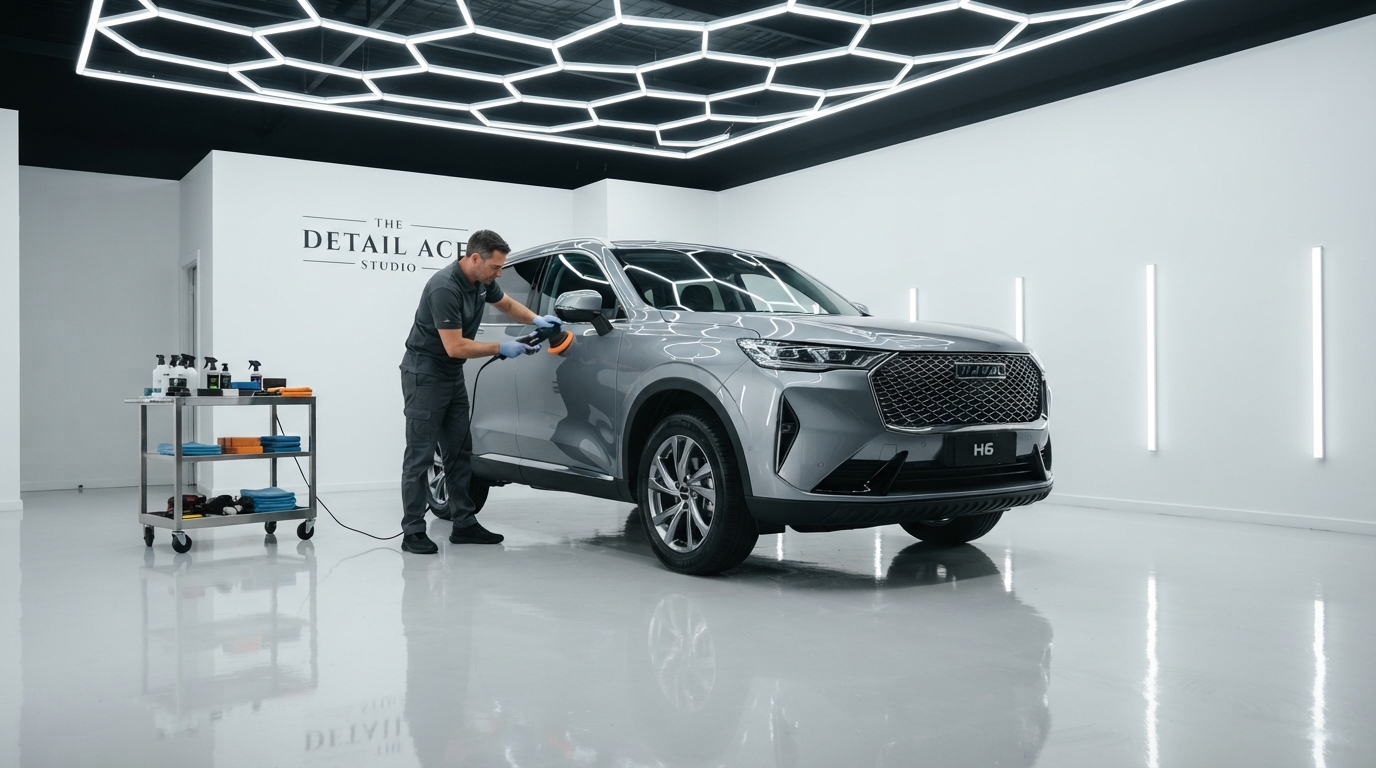
Modern paint systems require a surgical, multi-stage protocol. On a Haval H6 1.5T / HEV in Titanium Grey, the objective is to eliminate surface defects, halt environmental degradation, and anchor advanced hydrophobic polymers or physical barrier films.
- 1Multi-Stage Decontamination: Execute a pH-neutral pre-wash followed by a contact wash using a two-bucket wash with grit guards to isolate abrasive road grit. Apply a reactive iron fallout remover to chemically dissolve embedded metallic rail dust from brake discs. Follow with a synthetic clay mitt using dedicated slip lubricants to eliminate sub-surface industrial fallouts without marring the 2H clear coat.
- 2Ultrasonic Digital Paint Thickness Gauging: Measure paint depth across all Titanium Grey metallic panels using a calibrated ferrous/non-ferrous digital coating gauge. Record baseline thicknesses (averaging 98–110 microns across the hood, roof, and quarter panels) to establish the safe clear coat removal budget (never exceeding 25% of total clear coat volume).
- 3Primary Machine Paint Correction: Mount German Koch-Chemie H9 Heavy Cut on a high-torque rotary polisher fitted with an open-cell wool pad for localized deep defect removal, or utilize a heavy-cut foam pad on a 15mm-throw DA polisher. Eliminate sub-surface swirl marks, isolated deep scratches, and severe water spots caused by mineral deposits.
- 4Secondary Refining & Micro-Cut Finishing: Transition to German Koch-Chemie M3 Micro Cut paired with a soft reticulated foam finishing pad on a DA polisher. Operate between 3,500 to 4,200 OPM (oscillations per minute) to clear compounding haze and establish high gloss across the complex metallic flake distribution of the Titanium Grey finish.
- 5Panel Sterilization: Thoroughly mist and wipe all corrected surfaces with a 70/30 isopropyl alcohol and solvent inspection spray to strip lubricating carrier oils, confirming that defects are permanently leveled rather than cosmetically masked.
- 6Chemical Quartz Matrix Anchoring: Apply GYEON quartz coatings (Mohs EVO or Syncro) via cross-hatch applicator passes. Allow flash times strictly calibrated to ambient room humidity, buffing off residue with edgeless 300 GSM microfibers to cure a crystalline SiO₂ shell that prevents tubewell bore water calcium etching. Alternatively, apply an ultra-fast hydrophobic layer via GYEON CanCoat Pro for localized maintenance.
- 7Physical Impact & Chassis Protection: Install 7.5 mil or 8.5 mil TPU Paint Protection Film (PPF) across high-impact strike zones (front bumper, hood, side mirrors, and A-pillars) to defend against high-velocity road debris. Coat exposed structural floor cavities with HB Body U-100 Rubberized stone chip shield to seal seams against gravel abrasion, saline moisture, and chemical corrosion.
5. Frequently Asked Questions (FAQ)
How did Meguiar's furniture polish lead directly to modern paint correction?
Frank Meguiar Jr.'s formulas were designed to balance surface cleaning with uniform abrasion on wooden carriage varnishes. When the automotive sector transitioned from early varnishes to modern clear coats, Meguiar’s engineered this mechanical leveling concept into Diminishing Abrasive Technology (DAT), establishing the foundation for modern clear-coat compound science.
Why will legacy carnauba waxes and polishes fail to protect a Haval H6 in local climates?
Traditional carnauba-based formulas melt at surface temperatures exceeding 80°C—a threshold frequently surpassed on metal panels under direct sunlight. Furthermore, traditional waxes offer zero resistance against aggressive pH variations, dissolving quickly against acidic rainfall and leaving the Haval H6’s soft clear coat vulnerable to tubewell bore water calcium etching.
What is the advantage of using Koch-Chemie compounds over vintage DAT polishes on Titanium Grey paint?
Titanium Grey paint hides minor micro-hazing, meaning vintage diminishing abrasives can leave behind unchecked microscopic marring that dulls metallic flake brilliance. Precision systems like Koch-Chemie H9 and M3 rely on homogeneous, non-clustering aluminum oxide granules that cut uniformly and finish cleanly on softer clear coats without depleting paint depth.
When should a Haval H6 receive 7.5 mil or 8.5 mil TPU PPF instead of ceramic coating alone?
Ceramic coatings provide chemical resistance (pH 2–12), UV stability, and ease of washing, but they cannot absorb kinetic impact. A 7.5 mil or 8.5 mil TPU Paint Protection Film provides an elastomeric urethane shock-absorption layer that physically arrests high-speed gravel impacts, rock chips, and deep key scratches on vulnerable leading edges.