
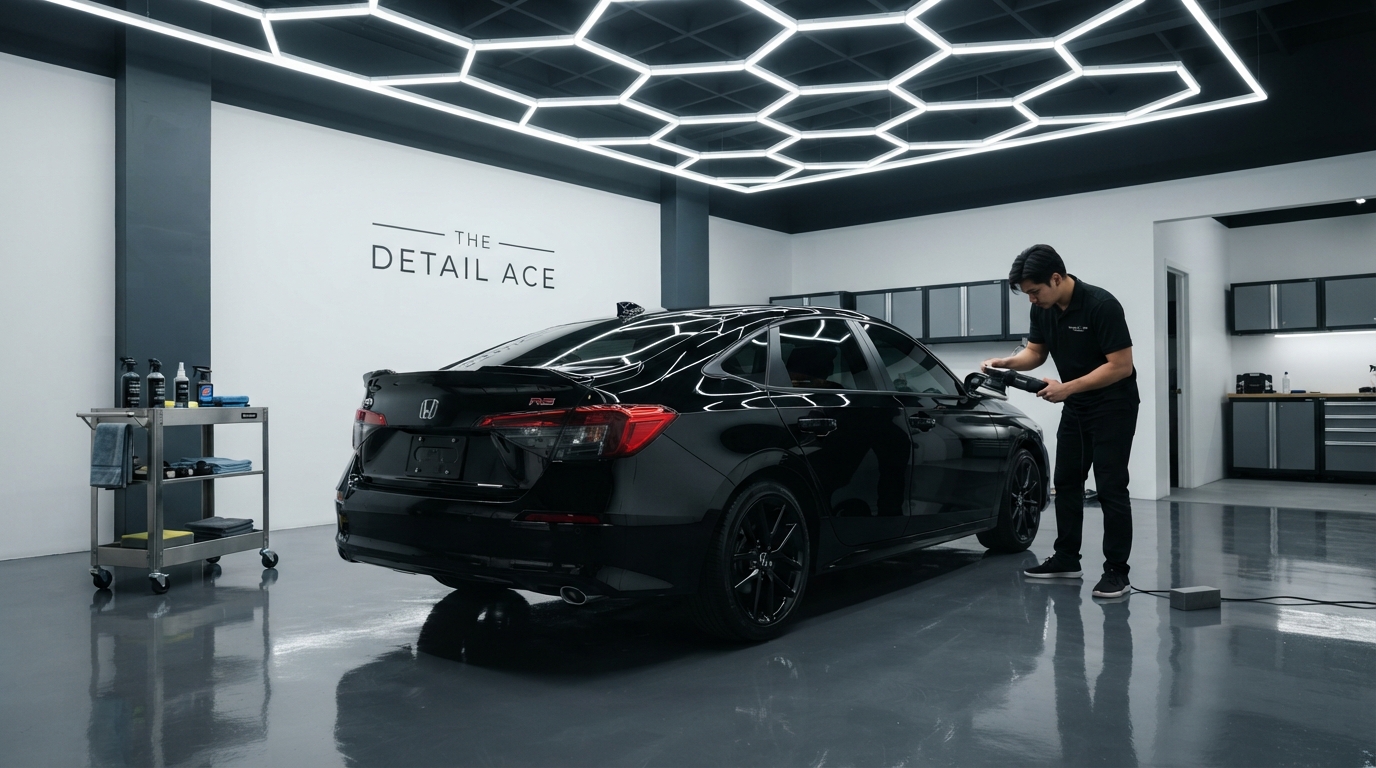
> Quick Takeaway (TL;DR): The real cost of professional car detailing in Pakistan ranges from PKR 25,000–45,000 for multi-stage paint correction up to PKR 320,000–480,000 for full-body 8.5 mil TPU paint protection film (PPF). Genuine costs reflect clear coat preservation, imported cleanroom-grade chemistries, and micron-level optical leveling.
The Real Cost of Professional Car Detailing in Pakistan
The cost of detailing in Pakistan is often obscured by roadside service stations offering superficial "polish and wax" treatments for PKR 3,000 to PKR 8,000. These low-cost services utilize silicone-heavy glazes that temporarily mask defects while rotary operators strip away valuable clear coat.
A true professional detailing service executed by The Detail Ace is a precision engineering discipline. It restores, hardens, and preserves a vehicle's exterior surface against Pakistan's unforgiving environment: extreme UV index ratings, high ambient PM2.5 levels, and ubiquitous tubewell bore water calcium etching.
The Engineering Reality: Why Paint Fails in Pakistan
Modern automotive factory finishes—exemplified by the Honda Civic 11th Gen RS Turbo in Crystal Black (NH-731P)—are notoriously fragile. Honda applies an ultra-thin factory clear coat measuring merely 28 to 35 microns (within a total paint depth of 95 to 110 microns), registering a soft 2H pencil hardness.
Crystal Black reveals every micro-abrasion:
- Tubewell Bore Water Calcium Etching: Groundwater across Pakistani cities typically exhibits Total Dissolved Solids (TDS) exceeding 500–1200 ppm. When calcium bicarbonate evaporates under direct sunlight, it forms deep, sub-surface mineral rings that cannot be washed away.
- Aggressive Mechanical Abrasion: Improper single-bucket wash techniques with rough cloths generate severe swirl marks and spiderweb scratches across soft clear coat panels.
- Chemical Contamination: Industrial emissions and alkaline road grime cause localized oxidation, accelerating clear coat failure if left unprotected.
Preserving soft paint systems requires calculated clear coat removal (no more than 2 to 4 microns during correction) followed by hard-barrier chemical or physical protection.
Detailed Cost Breakdown & Package Specifications
The table below outlines authentic market pricing for professional detailing services at The Detail Ace, based on the Honda Civic 11th Gen chassis:
| Package Tier | Primary Chemistry / Material | Key Protection Specs | Realistic Durability | Investment Range (PKR) |
|---|---|---|---|---|
| Correction & Sealant | Koch-Chemie M3 Micro Cut + GYEON CanCoat Pro | SiO2 spray coating; 100° contact angle; pH 2–11 resistance | 6–12 Months | 28,000 – 42,000 |
| Multi-Stage Quartz Ceramic | Koch-Chemie H9/F6/M3 + GYEON Mohs / Syncro | 9H pencil hardness; polysilazane cross-linking; pH 2–13 resistance | 24–48 Months | 65,000 – 115,000 |
| Front Impact Protection | 7.5 mil TPU (Aliphatic Polyurethane) | Self-healing clear coat; 190-micron total barrier; high tensile resistance | 5–7 Years | 110,000 – 160,000 |
| Complete Surface Armor | 8.5 mil TPU PPF + HB Body U-100 Underbody | Full physical rock-chip barrier; stone chip shield for floor pans | 7–10 Years | 320,000 – 460,000 |
The Detail Ace 5-Stage Paint Restoration Protocol
Eliminating defects on a Crystal Black Civic without compromising its thin factory clear coat requires a systematic cleanroom process:
- 1Multi-Stage Chemical & Mechanical Decontamination: The vehicle undergoes a pH-neutral foam pre-wash to lift road film without surface contact. Technicians apply a dedicated iron-fallout remover to dissolve embedded brake dust, followed by a fine-grade clay bar using dedicated lubrication to pull out particulate matter. Routine cleaning uses a strict two-bucket wash with grit guards.
- 2Ultrasonic Clear Coat Depth Profiling: Technicians log 40+ measurement points using a digital ultrasonic paint depth gauge. This verifies remaining clear coat levels to establish safe cutting parameters before any machine touches the finish.
- 3Compound & Polish Defect Elimination: Deep scratches, swirl marks, and severe water spots are leveled using a rotary polisher paired with German Koch-Chemie H9 Heavy Cut compound and wool/microfiber cutting pads. Refinement follows on a dual-action (DA) polisher using Koch-Chemie F6 Medium Cut and Koch-Chemie M3 Micro Cut to remove compounding haze and produce high gloss without trail marks. Controlled wet sanding (3000 to 5000 grit) is reserved exclusively for deep isolated scratches.
- 4Residue Stripping Panel Wipe: Surfaces are treated with an alcohol-based panel preparation spray. This extracts all polishing oils, revealing genuine defect removal rather than masked paint.
- 5Protective Barrier Application:
- Ceramic Route: Application of GYEON quartz systems (Mohs or Syncro) provides dense molecular cross-linking, hydrophobic self-cleaning, and chemical resistance.
- PPF Route: Installation of 7.5 mil or 8.5 mil TPU films on a wet slip-solution matrix delivers stone-chip deflection and thermal self-healing.
- Chassis Protection: Floor pans and exposed wheel wells receive HB Body U-100 Rubberized stone chip shield to resist corrosive water splash, gravel impact, and structural degradation.
The Hidden Cost of Cheap Local Detailing
Low-cost detailing shops produce structural damage that is expensive to remediate:
- Clear Coat Depletion: Inexperienced operators using aggressive rotary polishers with generic rubbing compounds often strip 10 to 15 microns of clear coat in a single session. This leaves paint vulnerable to UV failure, oxidation, and clear coat peeling within 12 to 18 months.
- Silicone Filler Washout: Cheap compounds rely on mineral oil and silicone fillers that mask defects temporarily. After two to three washes, these fillers wash away, exposing untouched swirl marks and rotary buffer trails.
- High Repaint Costs: Re-spraying a single panel on an 11th Gen Civic to match Crystal Black (NH-731P) factory metallic flake costs PKR 18,000–25,000 per panel, while permanently depreciating the car's resale value due to non-original paint meter readings.
Investing in calibrated correction and validated ceramic or TPU installations at The Detail Ace protects both the physical paint layer and long-term resale equity.
Frequently Asked Questions
Why is ceramic coating priced significantly higher than traditional wax?
Traditional waxes are organic carnauba or synthetic polymers that sit loosely on the paint and break down at 60°C to 80°C—temperatures common on car bonnets in direct sunlight. Professional ceramic coatings (such as GYEON quartz formulations) chemically bond to clear coat at a molecular level, resisting heat up to 300°C and offering strong chemical resistance (pH 2–13) against bird droppings and industrial fallout for multiple years.
What is the practical difference between 7.5 mil and 8.5 mil TPU PPF?
Both films utilize an aliphatic polyurethane core with self-healing topcoats. However, 8.5 mil TPU provides higher tensile strength and impact absorption, making it better suited for highway driving where high-velocity gravel and debris can penetrate thinner films. 7.5 mil TPU offers easier conformability over complex curves and serves as a balanced option for city-driven vehicles.
Can professional detailing remove deep calcium etching caused by tubewell bore water?
Mineral etching that remains within the upper 2 to 4 microns of the clear coat can be safely leveled using Koch-Chemie H9 Heavy Cut on a rotary polisher or spot wet sanding. However, if unpurified groundwater has remained on the panel long enough to etch down through the color base coat, full correction is impossible without repainting. Early decontamination is essential.
> Related Master Guide: For an authoritative technical deep-dive into this subject, read our clinical analysis on Why Cheap PPF Turns Yellow and Damages Clear Coat.
> Related Master Guide: For an authoritative technical deep-dive into this subject, read our clinical analysis on The Story of Meguiar's: How Furniture Polish Shaped Modern Car Detailing.