
TPU vs TPH vs PCU PPF in Pakistan: Technical Guide to Avoiding Paint Ruin & Market Scams
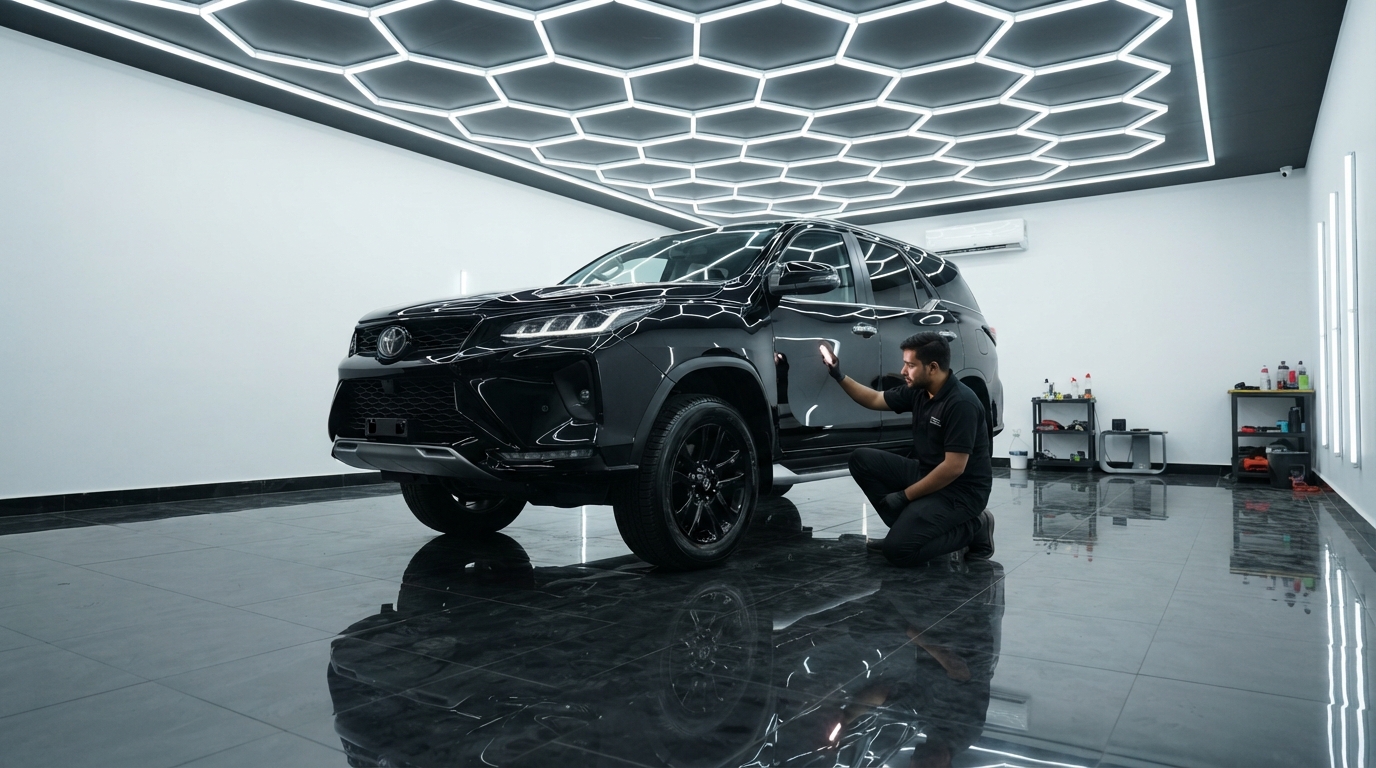
A customer brought in a 2023 Toyota Fortuner Legender in Phantom Black to our detailing studio. Six months earlier, an installer charged him Rs. 140,000 for what was claimed to be an "imported American-grade TPU paint protection film."
Under our cleanroom inspection lamps, the film was badly hazing and yellowing. When we tested a corner on the hood with a heat gun to check for self-healing, the plastic crinkled, gave off a pungent chlorine odor, and refused to smooth out. When we carefully lifted an edge, the aggressive adhesive remained welded to the factory clear coat, tearing away clear coat flakes down to the basecoat.
The customer had been misled with a low-cost roll of plasticized PVC (sold locally as TPH). His factory paint was irreversibly compromised.
> Quick Verdict: Never install TPH or PCU wraps to cut costs on high-end vehicles. Under intense solar UV exposure, plasticizers boil off within 6–12 months, baking toxic solvent adhesive directly into your clear coat. Only invest in genuine, 100% Aliphatic TPU with a cast cap sheet.
The Technical Science: Factory Paint vs. Low-Grade Films
To understand why low-grade films ruin cars, consider standard factory automotive paint specifications:
Typical Factory Multi-Layer Paint Structure
| Paint Layer | Composition & Role | Typical Thickness | Hardness Rating |
|---|---|---|---|
| Clear Coat | Acrylic-melamine resin UV shield | 35 – 45 µm | 2H – 3H |
| Base Coat | OEM color pigment & metallic flake | 15 – 20 µm | N/A |
| Primer / E-Coat | Leveling surfacer & anti-corrosion dip | 25 – 35 µm | 4H – 5H |
| Vehicle Substrate | Galvanized steel / ABS composite | Base Body | Substrate |
Total paint depth averages between 95 and 115 microns. The sacrificial clear coat at the top is barely 35 to 45 microns thick—thinner than a single post-it note. Factory urethane clear coats sit at a relatively soft 2H to 3H on the pencil hardness scale.
Understanding the Film Polymers
- PVC (Polyvinyl Chloride): Rigid vinyl made flexible by synthetic plasticizers. It has zero self-healing capability. Under intense UV radiation, plasticizers off-gas, causing the film to shrink, crack like dried mud, and bond its glue permanently to the clear coat.
- TPH (Thermoplastic Polyolefin / PVC Hybrid): Marketed locally under names like "hybrid TPU" or "Singapore tech." In reality, TPH is still a PVC-based film with a minor polyol blend. It turns yellow within months and risks clear coat delamination during removal.
- PCU (Polycarbonate Polyurethane): A step above TPH using polycarbonate resins. While more durable than PVC, PCU lacks the high elasticity needed for deep contours and intricate bumper angles.
- Aliphatic TPU (Thermoplastic Polyurethane): The gold standard. Built from an aliphatic polycaprolactone molecular backbone that resists UV degradation. It features an optical acrylic pressure-sensitive adhesive (PSA) that releases cleanly without damaging paint, coupled with a cross-linked top coat that self-heals swirl marks under mild heat.
Detailed Technical Comparison
| Specification / Parameter | PVC Wrap Film | TPH ("Hybrid" Film) | PCU (Modified Polyurethane) | 100% Aliphatic TPU |
|---|---|---|---|---|
| Base Polymer Chemistry | Monomeric PVC | Plasticized PVC | Polycarbonate Urethane | Aliphatic Polycaprolactone |
| Total Thickness | 4.0 – 5.5 Mils | 6.0 – 6.5 Mils | 6.5 – 7.5 Mils | 8.0 – 10.0 Mils |
| Tensile Strength | < 15 MPa (Snaps easily) | 20 – 25 MPa | 35 – 45 MPa | > 60 MPa (High elasticity) |
| Elongation at Break | 80% – 120% | 150% – 200% | 220% – 280% | > 400% |
| Top-Coat Self-Healing | None | Non-existent or fake wax coat | Minimal | Instant to moderate heat |
| Chemical Resistance | Weak | pH 5 to 8 | pH 3 to 10 | pH 1 to 14 (Full shield) |
| Heat Resistance | Up to 60°C | Up to 70°C | Up to 85°C | Up to 125°C+ |
| Expected Lifespan | 3 to 6 months | 6 to 12 months | 18 to 24 months | 5 to 10 Years |
| Clear Coat Safety (Removal) | Extreme Risk (Paint damage) | High Risk (Adhesive welding) | Moderate to High | Safe (Clean release) |
| Realistic Full SUV Cost | PKR 45,000 – 65,000 | PKR 75,000 – 120,000 | PKR 150,000 – 220,000 | PKR 350,000 – 550,000+ |
Cleanroom PPF Application Workflow
Installing genuine aliphatic TPU on modern vehicles demands a controlled environment to ensure zero trapped dust nibs and flawless edge adhesion:
- 1Stage 1: Multi-Stage Decontamination
- High-pressure deionized rinse, pH-neutral citrus wash, and chemical iron fallout removal.
- Fine-grade synthetic clay bar glide to lift industrial fallout, road tar, and overspray.
- 2Stage 2: Paint Inspection & Correction
- Digital Paint Depth Gauge (PTG) inspection across all panels.
- Dual-action machine polish to eliminate factory micro-marring and jewel the paint to peak clarity.
- 3Stage 3: Solvent Stripping & Surface Prep
- Pure Isopropyl Alcohol (IPA) panel wipe to strip all polishing oils.
- Compressed air purge of all panel seams, badges, and grille crevices.
- 4Stage 4: Cleanroom Slip & Tack Application
- Climate-controlled bay misting to drop atmospheric dust.
- Precision-cut patterns applied using surgical-grade slip solution and specialized urethane squeegees.
- 5Stage 5: Edge Wrapping & Infrared (IR) Curing
- 360-degree edge wrapping into panel seams to prevent pressure-washer lifting.
- Digital IR heat lamps cure film at 90°C to activate adhesive cross-linking.
Spotting Market Scams: 3 Workshop Verification Tests
Before authorizing a PPF installation, ask the installer for a small sample scrap and verify with these simple tests:
- 1The Stretch & Recovery Test: Pull a two-inch strip of the film firmly. Genuine TPU stretches smoothly up to 400% and recovers its structure under warm water or hot air. TPH resists, discolors, and leaves permanent hazy white stretch marks.
- 2The Flame & Odor Test: Light a small sliver with a lighter. True TPU burns cleanly with very little smoke and a light paraffin scent; its melted bead stays soft and elastic. PVC/TPH burns with black sooty smoke and an unmistakable acrid chlorine stench.
- 3The Solvent / Thinner Rub: Rub a drop of lacquer thinner onto the glossy face with a microfiber towel. TPH topcoats turn sticky or dissolve within seconds. Genuine TPU is chemically inert and wipes clean with zero optical degradation.
Frequently Asked Questions (FAQs)
1. Why are PPF quotes in Pakistan so widely spread—from Rs. 80,000 to Rs. 500,000+?
The price gap reflects the underlying raw material. An installer quoting Rs. 80,000 to Rs. 120,000 is applying an unbranded, low-grade Chinese TPH or PVC film with cheap rubber adhesive. Installers quoting Rs. 350,000 to Rs. 500,000 are using authentic optical-grade Aliphatic TPU from proven chemical resin producers (such as Lubrizol or Covestro base resins).
2. Can PPF be applied safely over repainted panels?
Only if the repainted panel was baked properly in an authentic paint booth and allowed to off-gas for at least 21 to 30 days. If you cover fresh paint with PPF before solvents evaporate, the trapped solvents cause film hazing and blisters.
3. Will PPF prevent high-speed rock chip damage?
Genuine 8 to 10 Mil Aliphatic TPU will absorb and deflect the vast majority of high-speed highway debris and stone impacts without allowing the projectile to reach factory paint.
4. Is it safe to apply a ceramic coating on top of TPU PPF?
Yes, applying a PPF-specific ceramic coating creates an ultra-slick hydrophobic layer over the film, preventing mineral water spots and soot from bonding to the self-healing topcoat.
> Related Master Guide: For an authoritative technical deep-dive into this subject, read our clinical analysis on Is PCU Film Worth the Extra Cost Over Standard TPU?.