
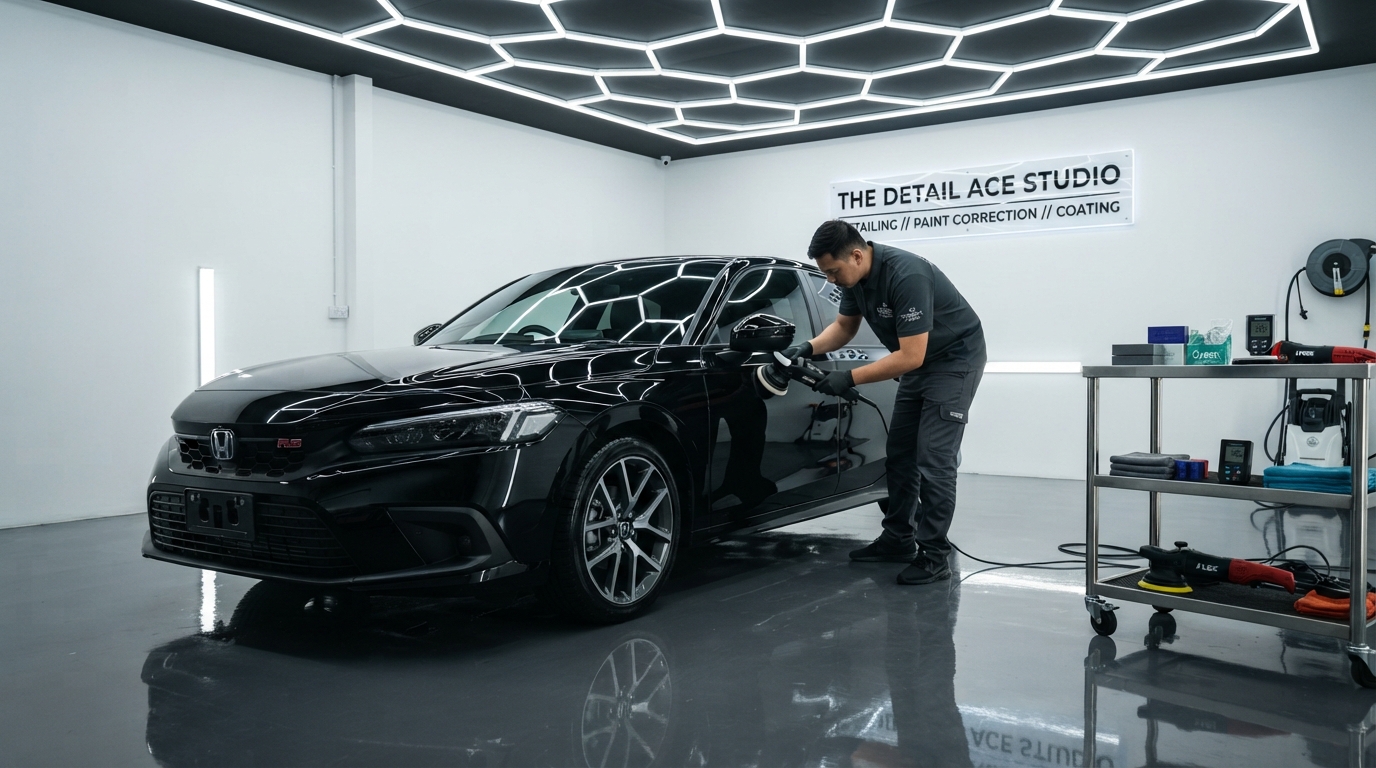
> Quick Takeaway (TL;DR): Meguiar's Ultimate Compound cuts structural surface defects (swirl marks, calcium etching, P1500–P2000 wet sanding marks) by removing 2–4 microns of clear coat using Super Micro-Abrasive Technology (SMAT). Meguiar's Ultimate Polish removes under 0.5 microns, utilizing conditioning oils and sub-micron abrasives to eliminate DA micro-marring and amplify optical depth. For an 11th Gen Honda Civic RS in Crystal Black, compounding removes true defects but leaves haze on the soft clear coat, necessitating Ultimate Polish as an essential secondary finishing step. Bottles retail locally between PKR 4,800 and PKR 6,500.
Mechanical Engineering and Chemical Principles: Clear Coat Dynamics
Modern automotive finishes rely on an electrodeposition primer, a pigmented base coat, and a protective acrylic-polyurethane clear coat. Factory clear coats on Japanese vehicles—most notably the 11th Generation Honda Civic RS Turbo in Crystal Black Pearl (Paint Code: NH-731P)—are exceptionally thin and soft. Factory clear coats range between 30 and 38 microns in thickness with a low pencil hardness rating of B to HB.
Excessive friction or overly aggressive compounds permanently deplete this protective sacrificial layer. The clear coat contains vital UV inhibitors concentrated in its upper 50 percent; shaving down more than 25 percent (approximately 8 to 10 microns) causes premature delamination, oxidation, and clear coat failure under intense solar radiation. Selecting between cutting compounds and finishing polishes is an engineering calculation based on paint thickness, defect depth, and resin hardness.
Meguiar's Ultimate Compound uses engineered aluminum oxide crystals suspended in an emulsion carrier. These microscopic cutting agents retain their size and geometry throughout the correction cycle (SMAT: Super Micro-Abrasive Technology), shearing off damaged resin uniformly rather than breaking down like diminishing abrasives. It levels jagged scratch shoulders, eliminating moderate-to-heavy spiderweb scratches, wash marring, and tubewell bore water calcium etching.
Meguiar's Ultimate Polish functions on a completely different chemical and physical principle. It incorporates a fraction of the abrasive load found in the compound, suspended inside a matrix rich in synthetic glazing oils and conditioning agents. Its mechanical task is to eliminate the micro-marring or buffer trails left behind by the compound's aggressive cut, flattening the surface topography down to microscopic smoothness for maximum high gloss and optical clarity.
Comparative Technical Specifications
| Engineering Metric / Parameter | Meguiar's Ultimate Compound | Meguiar's Ultimate Polish |
|---|---|---|
| Primary Functional Purpose | Mechanical paint correction & defect removal | Surface refinement, gloss enhancement & oil nourishing |
| Abrasive Chemistry | High-load Super Micro-Abrasives (SMAT) | Ultra-fine sub-micron polishing alumina |
| Cut Rating (Internal Scale 1–10) | 8.0 / 10 | 3.0 / 10 |
| Finish Rating (Internal Scale 1–10) | 6.0 / 10 | 9.5 / 10 |
| Average Clear Coat Removal | 2.0 to 4.5 microns (Pad & Machine Dependent) | < 0.5 microns (Non-destructive) |
| Defect Level Capability | P1500–P2000 sanding marks, water spots, moderate swirls | Buffer haze, DA micro-marring, light towel wash marks |
| Filler / Glazing Oil Content | Minimal | High (synthetic nourishing oils) |
| Recommended Machine Pairing | DA Polisher (5000–5800 OPM) / Rotary (1200–1500 RPM) | DA Polisher (3800–4500 OPM) / Rotary (800–1000 RPM) |
| Recommended Pad Substrate | Medium-to-dense foam cutting or microfibre cutting pad | Soft, open-cell foam finishing pad |
| Coating Pre-requisite | Requires secondary refinement on dark soft paints | Must be chemically stripped with IPA before ceramic application |
| Retail Price Range (Pakistan) | PKR 5,000 – 6,500 (450ml / 15.2 oz) | PKR 4,800 – 6,200 (450ml / 15.2 oz) |
Paint Diagnostic Matrix: Determining Your Paint's Exact Requirement
Diagnosing whether to use Ultimate Compound, Ultimate Polish, or a sequential two-stage process requires precise paint inspection under high-CRI (Color Rendering Index) LED illumination:
#### Case A: Deploy Meguiar's Ultimate Compound
- Visible concentric swirl marks (spiderweb scratches) under direct sunlight or inspection lamps.
- Tubewell bore water calcium etching etched into the top clear coat strata.
- Bird dropping chemical burns that have wrinkled the surface resin.
- Wet sanding mark removal following spot orange peel leveling with P2000/P3000 grits.
- Severe environmental fallout oxidation causing the clear coat to feel rough and look grayed out.
#### Case B: Deploy Meguiar's Ultimate Polish
- Paint is structurally free of deep defects but lacks jetness and mirror reflection.
- Correcting micro-marring, DA haze, or light pad scouring caused by a prior heavy compounding phase.
- Preparing garage-kept or rarely driven vehicles for synthetic paste waxes or carnauba top coats.
- Removing extremely shallow wash marks caused by improper drying microfibers on soft Japanese clears.
#### Case C: The Soft Paint Dilemma (Honda Crystal Black NH-731P) On the 11th Gen Civic's soft Crystal Black finish, Meguiar's Ultimate Compound will level severe swirls quickly, but the firm foam cutting pad and micro-abrasives will leave a micro-haze (gray, cloudy halo effect). This paint system strictly requires a two-step approach: Ultimate Compound to correct physical defects, followed directly by Ultimate Polish on a soft open-cell foam pad to restore deep, defect-free optical reflection.
Technical Workflow: Multi-Stage Correction on Soft Clear Coats
To safely correct and refine soft automotive finishes like the 11th Gen Civic RS Turbo, execute this cleanroom-standard procedure:
- 1Stage 1: Multi-Stage Decontamination
Perform a non-contact pre-wash using high-pH foam to dissolve road grime, followed by a two-bucket wash with grit guards and a balanced shampoo. While wet, decontaminate ferrous metal deposits using a pH-neutral iron fallout remover, rinse, and lubricate the surface for mechanical decontamination using a fine-grade synthetic clay bar to extract embedded airborne particulate matter.
- 2Stage 2: Paint Depth Gauge Metrology & Surface Masking
Measure the total paint thickness across every panel using a calibrated ultrasonic or magnetic paint depth gauge. Record baseline thicknesses across the hood, roof, and doors (expect 95–115 microns total on an 11th Gen Civic). Mask off edge lines, high-stress swage lines, rubber window seals, and plastic moldings using low-tack automotive masking tape to prevent edge burn-through.
- 3Stage 3: Micro-Abrasive Paint Correction (Ultimate Compound)
Mount a medium-density closed-cell foam cutting pad onto a dual-action (DA) polisher set to speed setting 4 to 5 (4,500–5,200 OPM). Apply 4 pea-sized drops of Meguiar's Ultimate Compound onto the pad. Work a controlled 2x2 foot section using 5 to 6 overlapping passes (horizontal then vertical) with moderate downward pressure, moving the machine at 1 to 2 inches per second. Wipe clean with a 400+ GSM plush microfiber towel and inspect under monochromatic LED light.
- 4Stage 4: Secondary Optical Refinement (Meguiar's Ultimate Polish)
Switch to a soft, open-cell finishing foam pad mounted on the DA polisher set to speed setting 3 to 4 (3,500–4,000 OPM). Dispense 3 small drops of Meguiar's Ultimate Polish. Execute 3 to 4 overlapping passes across the corrected section with light machine weight pressure only. The glazing oils and fine abrasives will remove compound haze, bringing out high gloss and jetting the black pigments without scouring the soft resin.
- 5Stage 5: Surface Sterilization & Protective Capping
If sealing the paint with traditional polymer waxes or carnauba pastes, apply them directly over the polished surface to bond with the rich polishing oils. If installing permanent protection—such as GYEON quartz ceramic systems (GYEON CanCoat Pro, Syncro, or Mohs)—the panel must be wiped down using a 30% Isopropyl Alcohol (IPA) solution or a dedicated panel wipe solvent to completely dissolve polishing oils, ensuring direct covalent bonding to bare clear coat.
Local Environmental Realities: Pakistan Automotive Conditions
Vehicles in Pakistan face unique environmental challenges that drastically accelerate paint degradation. Tubewell bore water calcium etching is common nationwide, where hard groundwater minerals (calcium carbonate, magnesium salts) bake onto black clear coats under 45°C+ summer ambient temperatures, creating mineral scale that car shampoos cannot dissolve.
When maintaining soft Japanese clears in this climate:
- Production Heavy Correction Alternatives: In professional detailing environments at The Detail Ace, severely damaged paints are addressed using heavy German compound systems such as Koch-Chemie H9 Heavy Cut or F6 Medium Cut on rotary machines, refined down with Koch-Chemie M3 Micro Cut on DA polishers to eliminate all holograms.
- Physical Paint Protection Film (PPF): For long-term protection on road-facing impact zones (bumpers, hood, front fenders), install 7.5 mil or 8.5 mil TPU (Thermoplastic Polyurethane) PPF. A 7.5 mil or 8.5 mil TPU film shields fragile clear coats from high-velocity highway gravel strikes and physical wash marring that compounds cannot safely prevent.
- Chassis Armor: Ensure complete vehicle integrity by treating exposed wheel wells, subframes, and vulnerable underbody structural floor pans with an HB Body U-100 Rubberized stone chip shield to prevent gravel abrasion and rust from standing monsoon water.
Frequently Asked Questions
#### Can Meguiar's Ultimate Compound burn through the soft clear coat of an 11th Gen Civic? Yes, if used aggressively on sharp body lines or paired with high-speed rotary polishers. The 11th Gen Civic features thin clear coats (30–38 microns), and hard-edged styling creases carry even thinner coverage. When using Ultimate Compound, stick strictly to a dual-action (DA) polisher, check clear coat depth before compounding, avoid resting on swage lines, and do not make more than 6 to 8 passes per section.
#### Must I wipe down paint with an IPA solvent after using Meguiar's Ultimate Polish? Only if you are installing a ceramic coating. Meguiar's Ultimate Polish leaves behind rich conditioning oils designed to improve gloss under traditional waxes and synthetic sealants. However, GYEON quartz ceramic coatings require an oil-free surface to form covalent bonds with the paint matrix; failure to wipe away polishing oils with a solvent degreaser will cause the coating to prematurely sheet off.
#### Can I skip Ultimate Compound and use only Ultimate Polish on a heavily swirled vehicle? No. Ultimate Polish lacks the mechanical cutting power to remove deeper swirl marks, wash scouring, or etched water spots. While its rich polishing oils will temporarily mask and fill microscopic imperfections, those defects will reappear after two or three rain cycles or basic washes. Deep scratches and spiderweb swirls require the SMAT abrasives in Ultimate Compound to physically level the damaged clear coat.
#### How frequently can I use Meguiar's Ultimate Compound on my vehicle? Ultimate Compound should be deployed sparingly—typically no more than once or twice during the lifespan of the vehicle. Frequent compound cycles will exhaust the limited 30–38 micron clear coat layer, leading to clear coat failure. Once primary defect correction is achieved, maintain the paint through scratch-free two-bucket washes with grit guards and preserve the finish with paint protection film or ceramic coatings.