
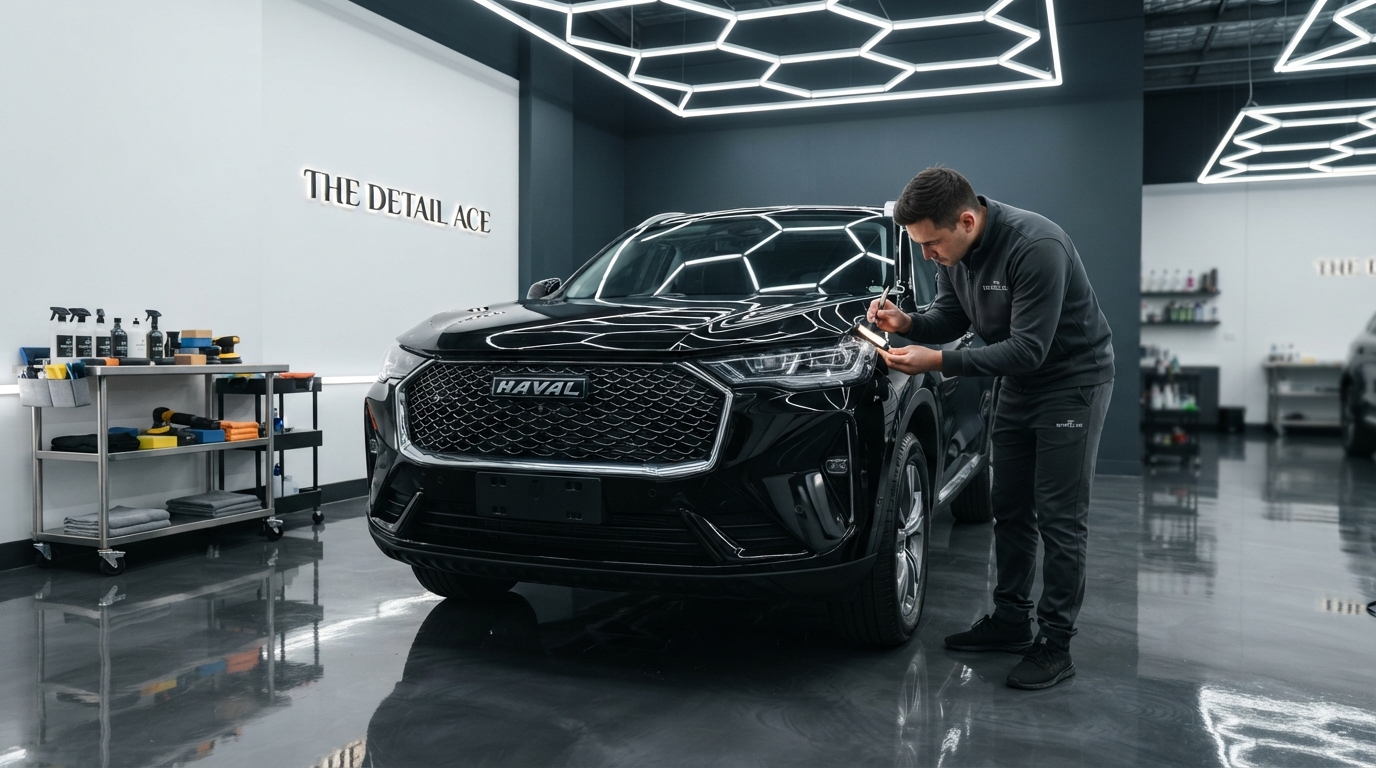
> Quick Takeaway (TL;DR): Yes. A front-end PPF package (Track Pack) covers 85% of high-velocity stone chip strike zones—bumper, full hood, front fenders, headlights, and side mirrors—for 35–40% of the cost of a full wrap. Utilizing 7.5 mil or 8.5 mil aliphatic TPU prevents irreversible stone-chip damage to thin factory clear coat while preserving your car's original resale value.
Technical Analysis: Clear Coat Thickness vs. Road Debris
Modern automotive factory finishes prioritize environmental standards, resulting in thinner, softer, waterborne paint systems. On modern crossovers like the Haval H6, Kia Sportage, or Hyundai Tucson, the total paint thickness averages 95 to 115 microns across metal panels. The sacrificial clear coat layer constitutes only 30 to 35 microns, registering a nominal pencil hardness of just 2H to 3H.
When driving at highway speeds, airborne gravel, stone chips, and road debris strike vertical forward-facing panels with high kinetic energy. This easily penetrates the thin 30-micron clear coat, creating deep stone chips that expose bare metal or plastic primers and accelerate oxidation.
Aliphatic Thermoplastic Polyurethane (TPU) functions as a high-density shock-absorbing shield. Engineered with an elastomeric cap layer, TPU absorbs and disperses impact shock laterally across its internal polymer chains.
The top-coat also features instant self-healing properties: heat from the sun or engine bay allows displaced polymers to re-align, eliminating wash-induced swirl marks and light spiderweb scratches.
Front-End Track Pack vs. Full Body vs. Ceramic Coating
| Technical Metric | Front-End Track Pack PPF | Full-Vehicle PPF Wrap | Multi-Year Quartz Ceramic |
|---|---|---|---|
| Material Chemistry | Aliphatic TPU + Acrylic PSA | Aliphatic TPU + Acrylic PSA | Polysilazane / SiO₂ Quartz |
| Physical Thickness | 7.5 mil or 8.5 mil | 7.5 mil or 8.5 mil | 2.0 to 3.0 microns (DFT) |
| Tensile Strength | > 30 MPa | > 30 MPa | Rigid crystalline layer |
| Elongation at Break | > 400% | > 400% | 0% (Non-elastic) |
| Stone Chip Deflection | High (Impact absorbing) | High (Impact absorbing) | Zero (Chemical defense only) |
| Chemical Resistance | pH 2.0 – 12.0 | pH 2.0 – 12.0 | pH 2.0 – 11.0 |
| Environmental Defense | Tubewell bore water, bugs, UV | Tubewell bore water, bugs, UV | Acid rain, dust adhesion |
| Expected Durability | 5 – 7 Years | 5 – 7 Years | 2 – 3 Years |
| Typical Cost Range | PKR 140,000 – 210,000 | PKR 380,000 – 550,000 | PKR 65,000 – 95,000 |
Strategic Recommendation for Pakistani Road Conditions
A Front-End PPF package (8.5 mil TPU on the front bumper; 7.5 mil TPU on the hood, fenders, and mirrors) paired with a multi-stage GYEON quartz coating (such as GYEON Mohs or Syncro) on the doors, roof, and tailgate delivers the optimal cost-to-protection ratio. This hybrid strategy isolates physical rock-chip defense to high-impact strike zones, while protecting all remaining panels against hard groundwater calcium etching, bird droppings, and UV clear coat oxidation.
Technical Installation & Paint Preparation Workflow
Installing front-end PPF on complex modern bumper curves requires strict cleanroom contamination control:
Stage 1: Multi-Stage Chemical & Mechanical Decontamination
- 1Perform a pre-wash foam soak to encapsulate road grime, followed by a pressure rinse.
- 2Execute a two-bucket wash with grit guards using a pH-neutral automotive shampoo.
- 3Apply an iron-fallout chemical remover across all forward-facing panels to dissolve embedded brake dust and industrial particulates.
- 4Mechanically decontaminate the clear coat using an ultra-fine synthetic detailing clay bar with dedicated slip solution.
Stage 2: Paint Correction & Defect Leveling
PPF permanently seals the paint beneath it. Any existing defects must be leveled prior to application:
- 1Compounding (Defect Elimination): Use a rotary polisher with a wool or heavy-cut foam pad and Koch-Chemie H9 Heavy Cut to eliminate deep scratches and transit marring.
- 2Intermediate Refining: Transition to a dual-action (DA) polisher with a medium-cut foam pad and Koch-Chemie F6 Medium Cut to correct compounding haze.
- 3Finishing Polish: Deploy a DA polisher with Koch-Chemie M3 Micro Cut on a soft finishing pad to eliminate remaining swirl marks and achieve high gloss clarity.
Stage 3: Solvent Panel Cleansing
Strip residual polishing oils using a 20% Isopropyl Alcohol (IPA) dilution or dedicated panel wipe solution. This ensures pure bare-surface clear coat contact, preventing premature edge lifting.
Stage 4: Cleanroom Wet Installation
- 1Position the vehicle inside a sealed, positive-pressure cleanroom to prevent airborne dust particles under the film.
- 2Spray a precision slip solution over both the clear coat and the exposed adhesive face of the 7.5 mil or 8.5 mil TPU film.
- 3Align the computer-cut or custom-extended pattern to the panel edges. Squeegee out the fluid using uniform, overlapping strokes from the center outward.
- 4Wrap all accessible edges—including the inner hood lip, headlight recesses, and fender returns—to eliminate exposed film borders.
Stage 5: Post-Heating & Ceramic Integration
- 1Post-heat all wrapped perimeter edges using an infrared heat lamp or heat gun at 80°C to lock adhesive memory.
- 2Apply GYEON CanCoat Pro or GYEON Mohs over the untreated rear panels, doors, and roof to ensure uniform high hydrophobicity and protection against tubewell water spots.
Frequently Asked Questions
Will there be a noticeable line or color difference on metallic paint?
When installed by a skilled technician, custom bulk installations wrap around panel edges (hood, fender edges, mirror caps), eliminating visible seams. Premium 7.5 mil and 8.5 mil aliphatic TPU films possess optical clarity (> 95% light transmission) that matches the refractive index of OEM clear coats, making the protected front end blend seamlessly with coated side doors.
Why choose 8.5 mil TPU over 7.5 mil for the front bumper?
The front bumper sits low to the ground and takes the highest concentration of direct gravel impacts. An 8.5 mil TPU film provides a thicker energy-absorbing core, reducing puncture risks during fast highway commuting. The 7.5 mil TPU option offers higher pliability for intricate contours while maintaining solid defense on hoods and fenders.
How does front-end PPF handle hard bore water and groundwater?
Untreated paint exposed to hard groundwater and bore-well car washing suffers severe calcium carbonate etching that eats through clear coats within weeks. High-grade aliphatic TPU features an elastomeric, non-porous top layer that prevents mineral deposit penetration and blocks solar UV radiation, stopping clear coat yellowing.
Can stone impacts damage paint through a 7.5 mil PPF layer?
At standard highway speeds (100–120 km/h), a 7.5 mil or 8.5 mil aliphatic TPU layer absorbs and deflects over 98% of typical aggregate road debris. Only large, sharp structural collisions with extreme kinetic energy can breach the film barrier.