
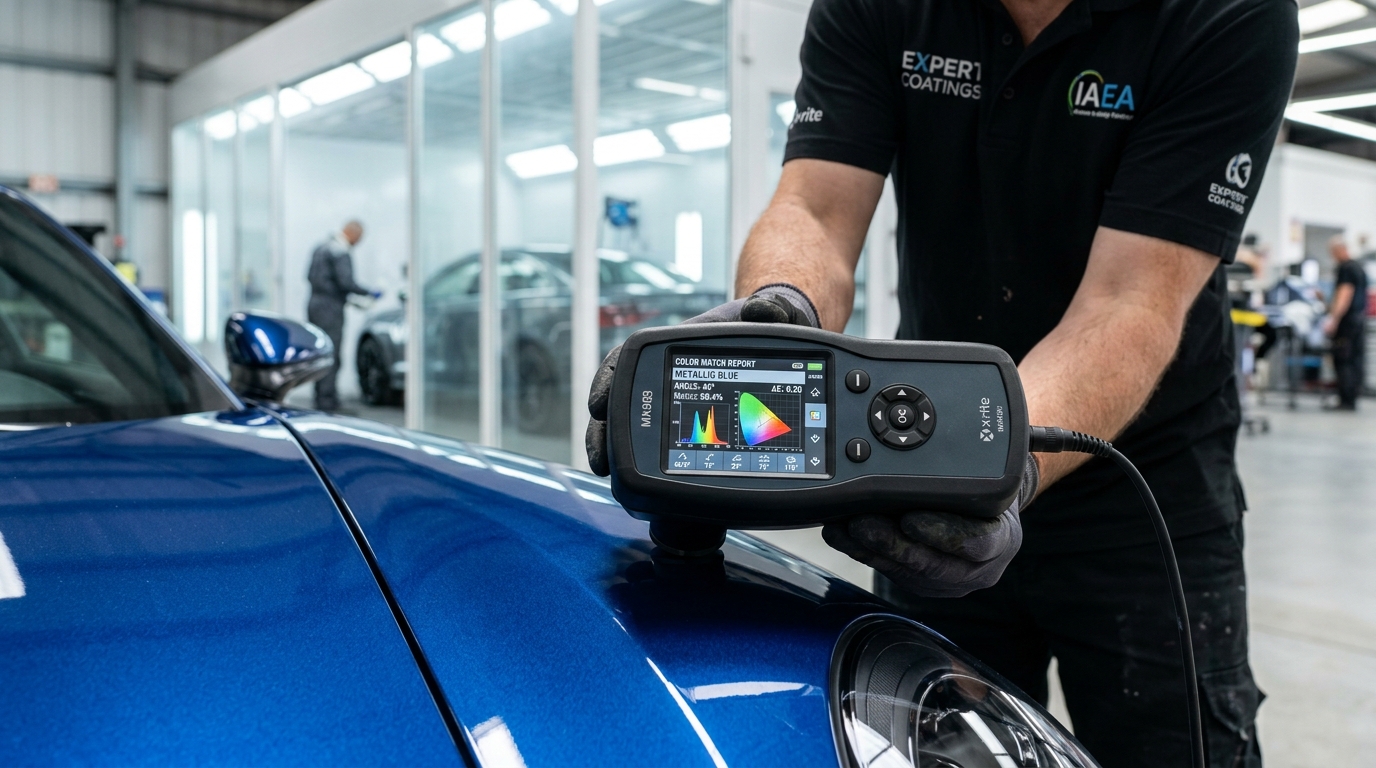
Few automotive issues are as frustrating as noticing a mismatched door or fender after a repaint job. Under showroom lighting or bright midday sunlight, mismatched metallic flake orientation, incorrect clear coat refraction, or improper shade variance immediately reveals accident repairs and destroys vehicle resale value.
Achieving a 100% invisible factory paint match is not guesswork—it is a rigorous scientific discipline combining optical colorimetry, digital spectrophotometers, and OEM paint blending techniques.
1. Why Factory Colors Vary: The "Color Code" Myth
Many vehicle owners believe that simply ordering paint by the vehicle's OEM color code (e.g., Toyota 040 Super White or 218 Attitude Black, Honda NH-731P Crystal Black Pearl, Suzuki Z7T Pearl White) guarantees an exact match. In reality, this is only the starting baseline.
Sources of Color Variance:
- Factory Batch Shifts: Car manufacturers produce vehicles across multiple assembly plants worldwide using different paint supplier batches (PPG, BASF Glasurit, Axalta, Kansai).
- Aging & UV Photo-Oxidation: Sunlight, heat, and acid rain subtly shift clear coat hue over 2 to 5 years, meaning fresh factory paint will look noticeably darker than adjacent aged panels.
- Substrate Differences: Bumpers and mirror caps are molded plastic (polypropylene), which electrostatically attracts metallic and pearl flakes differently than steel fenders and aluminum hoods.
2. The 3-Step Scientific Color Matching Workflow
Step 1: Multi-Angle Digital Spectrophotometer Analysis
Instead of relying on human visual estimates, a multi-angle spectrophotometer measures light reflectance at 5 distinct angles (15°, 25°, 45°, 75°, and 110°). It scans:
- Base color hue and chroma
- Metallic flake particle size and sparkle intensity
- Pearl/mica color travel and flip-flop effect
Step 2: Computerized Micro-Dosing Scales
The software matches the reading against tens of thousands of real-world global formula variants, calculating the exact pigment formula down to 0.01 grams.
Step 3: Test Spray-Out Cards (Visual Inspection under 5000K Sunlight)
Before touching the car, the paint technician sprays a metal test card, clears it, and inspects it under high-CRI color-matching daylight lamps (5000K–6500K) to verify 100% optical consistency across direct, oblique, and shadow angles.
3. The Art of Panel Blending vs. Hard-Edge Painting
❌ Hard-Edge Painting (Poor Quality):
[ Factory Fender ] | [ Freshly Painted Door (Hard Line) ]
Result: Obvious line where clear coat and color meet at the panel gap.

✔️ OEM Blending Technique (Master Body Shop Standard):
[ Factory Fender ] ← [ Feathered Color Blend ] → [ Base Repaired Area ]
                      [ Fully Cleared Edge-to-Edge with OEM Clear ]
Result: Color transitions invisibly across the panel; eye cannot detect transition.
Key Blending Rules:
- 1Feathering the Base Coat: The new base coat color is concentrated only over the primed repair area and progressively tapered into the original OEM color.
- 2Panel-Wide Clear Coating: Never spot-blend clear coat in the middle of a panel. The entire adjacent panel is scuffed and cleared continuously from edge to edge to prevent clear coat peeling at blend lines.
- 3Controlled Curing in Downdraft Bake Ovens: Cured at 60°C for 45 minutes to cross-link polyurethane resins to full OEM hardness without solvent pop or orange peel distortion.
Frequently Asked Questions (FAQ)
Why do plastic bumpers often look slightly different from metal fenders even from the factory?
Plastic parts flex and are painted on separate supplier lines using flexible paint additives, creating slight static orientation differences in metallic flakes. Professional body shops adjust flake density to ensure a seamless match to adjacent metal panels.
How soon after a body shop repaint can I apply Ceramic Coating or PPF?
Freshly painted panels release residual solvents (outgassing). A minimum waiting period of 3 to 4 weeks (or 2 weeks after full infrared bake curing) is required before installing PPF or ceramic coatings to prevent solvent entrapment or bubbling.
What causes orange peel texture on repainted panels?
Orange peel occurs when clear coat dries too rapidly before leveling out, often caused by incorrect solvent reduction, incorrect spray gun pressure, or poor booth temperature. Precision wet sanding with 2000–3000 grit followed by Koch-Chemie machine compounding restores mirror-flat OEM clarity.